







Quick answer:
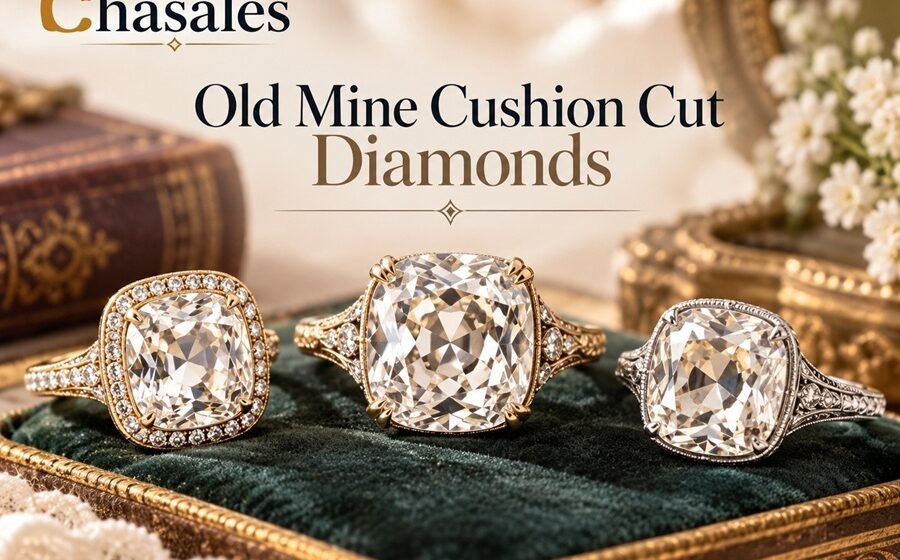
An old mine cut is an antique, hand-cut diamond with a soft cushion shape, a small table, a high crown, and a large flat culet. It sparkles in a warmer, softer way than a modern diamond. Its slight irregularities are a big part of why people love it.
Modern diamonds are cut to be as precise as possible. So it may surprise you that many brides now go looking for a stone that is a little uneven, a little soft around the edges, and completely one of a kind.
That is the appeal of the old mine cut. Below, I explain what it is, how it looks and sparkles, how to spot one, and what to ask before you buy.
What Is an Old Mine Cut Diamond?
The old mine cut is an early form of the brilliant-cut diamond. Jewellers describe it as the most common diamond cut from the early 1700s to the late 1800s, which covers the Georgian and Victorian eras. It has 58 facets, the same count as a modern round brilliant, but the proportions are very different.
Back then, cutters worked by hand and by eye. Before the first steam-driven bruting machine was patented in 1874, a cutter would take a natural octahedron (a rough diamond shaped like two pyramids joined at the base), round off the corners by hand, and then add facets to what was left.
That is why the shape is a soft square with rounded corners, like a small cushion.
How to Recognise an Old Mine Cut
Look for these signs:
- Cushion outline: A squarish shape with rounded corners, sometimes slightly uneven.
- Small table: The flat top facet is smaller than on a modern stone.
- High crown: The upper part of the diamond is tall and steep.
- Large culet: The tiny facet at the bottom is big enough to see from above, often as a small circle in the centre.
- Deep body: These stones usually sit deeper than modern diamonds.
- Slight asymmetry: No two stones are exactly alike, because each one was cut by hand.
Why Do Old Mine Cuts Sparkle Differently?
Old mine cuts were made for candlelight and gaslight, not bright LED lighting. Because the facets are larger, you tend to see broader flashes of colour, not the sharp, icy sparkle of a modern round brilliant.
Here is the simple difference:
- Modern cuts: Designed to return as much white light as possible. The look is bright and crisp.
- Old mine cuts: Designed to give a warm glow and coloured flashes. The look is soft, romantic, and full of character.
Neither is “better.” It is a matter of taste. If you love a crisp, icy sparkle, a modern cut may suit you more. If you love a soft, candlelit glow, you may fall for an old mine cut.
Why Are Brides Choosing “Imperfect” Diamonds?
1. Each stone is one of a kind
Because every old mine cut is hand-shaped, no two look the same. Many couples like the idea that their ring cannot be copied.
2. It carries history
Many of these stones are found in original Georgian or Victorian settings. Wearing one means wearing a piece of the past.
3. It fits the vintage ring trend
Old mine cuts pair beautifully with bezel settings, filigree, milgrain, and yellow or rose gold. If you read our guide on bezel-set engagement rings, you will see how well they go together.
4. Choosing an antique stone can be a thoughtful choice
Buying an existing antique means a stone is being worn again instead of a new one being produced. Whether this matters to you is personal, but many buyers mention it.
Old Mine Cut vs Old European Cut vs Modern Cushion
People often mix these up, so here is a simple guide.
| Feature | Old mine cut | Old European cut | Modern cushion cut |
|---|---|---|---|
| Outline | Cushion / squarish | Rounder | Cushion, more precise |
| Age | About 1700s–1800s | Late 1800s–early 1900s | Modern, machine-made |
| Table | Small | Small | Larger |
| Culet | Large, visible | Large, visible | Usually tiny or none |
| Look | Soft, warm, irregular | Soft, warm, round | Bright, uniform |
If you want the antique look but a rounder shape, ask to see an old European cut too. If you want a soft cushion shape with more modern sparkle, a modern cushion cut could be your match.
What to Check Before You Buy
- Ask for the story. Where does the stone come from, and is it in its original setting or has it been reset?
- Ask about repairs. Old stones may have small chips or wear. A trustworthy dealer will point these out.
- Look at it in different lights. View it by a window, in a shop, and under warmer lighting.
- Check the culet and the depth. A large culet is normal, but ask about chips or damage.
- Ask about certification. Cut grades are generally given for standard round diamonds, so for an antique stone, ask for a clear written description of its measurements, colour, clarity, and condition, and consider an independent valuation.
- Compare a few stones. Because each one is different, viewing several will help you see what you like.
- Choose a reputable seller. Look for clear return policies and a dealer who is happy to answer detailed questions.
How to Look After an Old Mine Cut Diamond
- Clean it gently with warm water, mild soap, and a soft brush.
- Have the setting checked by a jeweller once a year, since older settings may be worn.
- Remove it during heavy work, sports, and swimming.
- Store it on its own so it does not scratch other pieces.
[Add your experience here: for example, “When we looked at three stones side by side, the old mine cut looked warmer indoors and sparkled more in daylight.”]
Is an Old Mine Cut Right for You?
If you like a stone with personality, history, and a soft glow, an old mine cut may be a wonderful choice. If you want a very bright, perfectly symmetrical look, compare it with a modern cut first.
The best way to decide is simple: see a few in person, in different lights, and notice which one you keep coming back to.
Frequently Asked Questions
What is an old mine cut diamond?
It is an antique, hand-cut diamond from roughly the 1700s and 1800s, with a cushion shape, a small table, a high crown, and a large culet.
How is an old mine cut different from a modern cushion cut?
An old mine cut was shaped by hand and is often slightly uneven, with a large visible culet. A modern cushion cut is machine-made, more precise, and usually brighter.
Do old mine cut diamonds sparkle less?
They sparkle differently. The flashes are broader, softer, and often more colourful, which many people find romantic.
What is the difference between old mine cut and old European cut?
Both are antique. Old mine cuts are usually squarer and older, while old European cuts are rounder and came later.
Are old mine cut diamonds good for engagement rings?
Yes, if you love the vintage look. Ask about the stone’s condition, and make sure the setting protects it well.
How can I tell if a diamond is an old mine cut?
Look for a cushion-like outline, a small table, a high crown, and a large culet visible from the top. For certainty, ask a qualified gemmologist or reputable antique jeweller.
Are old mine cut diamonds more expensive than modern ones?
It depends on size, colour, clarity, condition, and the seller, so compare several options instead of assuming.
At Chasale, we believe the best ring is the one that feels like yours. Whether you choose a soft, hand-cut old mine diamond or a crisp modern stone, take your time, compare in different lights, and ask plenty of questions. For more simple, trustworthy guides on vintage and bridal jewellery, keep reading Chasale.

[…] Old Mine Cushion Cut Diamonds: The Rise of Imperfect Perfectionby Aarav KashyapSeptember 30, 2026 […]
[…] Old Mine Cushion Cut Diamonds: The Rise of Imperfect Perfectionby Aarav KashyapSeptember 30, 2026 […]
[…] Old Mine Cushion Cut Diamonds: The Rise of Imperfect Perfectionby Aarav KashyapSeptember 30, 2026 […]
[…] our guide to antique vs modern engagement rings explains the differences, and our article on old mine cushion cut diamonds covers one popular vintage-style […]