






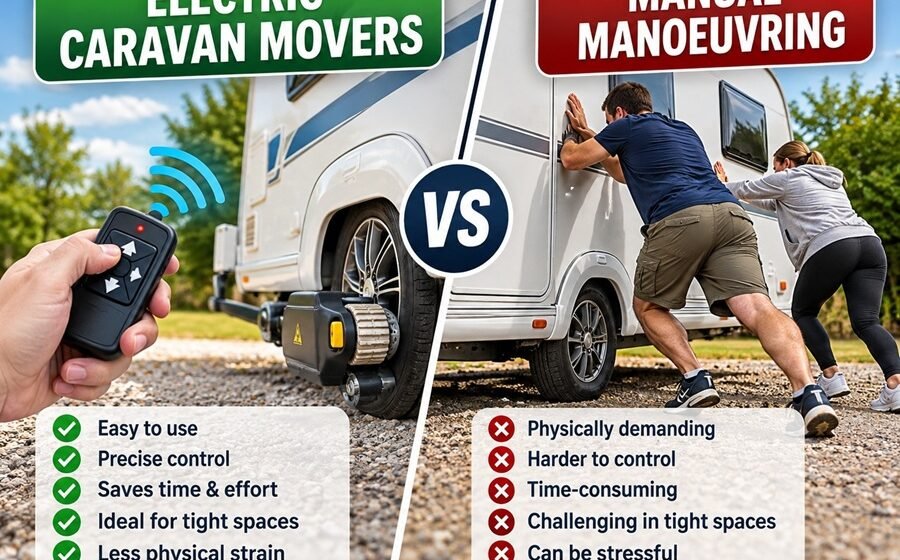

Anyone who has tried to reverse a caravan into a tight pitch alone, on a slope, with someone shouting directions from behind, already knows the real question here. It is not about technology. It is about whether you want to keep doing it the hard way.
Caravans have gotten heavier. Innerspring mattresses, dual-zone fridges, and air conditioning add weight that brochures rarely highlight. Getting this choice wrong means physical strain, body damage, and wasted time at every single stop.
Which is better?
Choose manual manoeuvring if: Your caravan is under 1,500kg loaded, you always have 2 people, and you park on flat, firm concrete.
Choose an electric caravan mover if: Your caravan is over 1.5 tonnes, you travel solo, your storage or pitch is tight or sloped, or you have any back/mobility issues. Above 1.5-2 tonnes, manual becomes unsafe for one person.
Key Takeaways
|
Takeaway
|
Why It Matters
|
|---|---|
|
Manual works fine under 1,500kg
|
Lighter single-axle vans are manageable on flat ground with two people
|
|
Electric becomes essential over 1.5-2 tonnes
|
Above this, manual is impractical and risky for a single person
|
|
Twin-axle caravans need 4 motors
|
Two motor units per axle for proper control, not just two total
|
|
Movers run off your leisure battery
|
No mains needed, but a flat battery = no mover
|
|
Full electric setup adds up to 80kg
|
That comes straight out of your payload allowance
|
Why This Decision Matters More Than It Seems
1. Injury Risk: Pushing a 1,700kg van on even a 5% incline puts enormous strain on your back and shoulders. One slip on wet grass can mean a serious injury.
2. Damage Risk: Manual manoeuvring in tight storage yards increases the chance of scraping against a fence, wall, or your own tow vehicle.
3. Time at Every Pitch: If you rely on someone directing you while you inch the tow vehicle back and forth, you add 10-15 minutes to every stop.
What is Manual Manoeuvring? It’s Not Just Pushing
Manual manoeuvring covers three different approaches:
1. Pushing by Hand
Exactly what it sounds like. You push via the tow bar and A-frame. Costs nothing, but requires strength and coordination. Only realistic for light vans on flat ground.
2. Manual Roller Movers
A step up. A roller system engages the tyres using a socket driver / winding handle. Similar to tightening a wheel nut. Once engaged, you still need physical effort or a basic handle to move it. Lower cost than electric, but engagement still needs effort.
3. Jockey Wheel Trolleys & Trailer Valet Systems
Portable trolleys that clamp to the tow ball or A-frame. Popular for lighter trailers. Brands like Trailer Valet can move up to 2,200kg but require 8-12% of the total weight as downward pressure on the ball to get traction. If your trailer is rear-heavy, it will just spin.
What is an Electric Caravan Mover?
Definition for Featured Snippet: An electric caravan mover is a 12V motorised system, usually mounted on the caravan’s axle, that uses rollers to drive the wheels directly, letting you reposition the caravan by remote control without pushing or towing it by hand.
How it works:
1. Frame Mounting: A frame bolts directly to the caravan’s chassis, usually one motor unit per wheel.
2. Power Source: The system draws power from your caravan’s leisure battery, not the mains. Never try to power a mover by plugging the caravan into mains electricity at home, it can permanently damage the control unit.
3. Control Unit: A small electronic brain, often tucked under a sofa or near the heater, receives your remote signals and sends power to the correct motor.
4. Engagement and Release: Rollers move into contact with the tyres when you activate the mover, then retract automatically once you are done.
There are two types: Manual-Engage (you wind the rollers on with a tool, then use remote to drive) and Fully Automatic (rollers engage at the press of a button – e.g., Purpleline Quattro Platinum). Automatic costs more but is far easier on a wet day.
Electric vs Manual: Side-by-Side Comparison
This table is designed to win the comparison featured snippet.
|
Factor
|
Electric Caravan Mover
|
Manual Manoeuvring
|
|---|---|---|
|
Physical Effort |
Minimal, remote-controlled
|
High, especially on inclines or heavier vans
|
|
Precision in Tight Spaces |
High, millimetre-level control via remote
|
Lower, depends on strength and helpers
|
|
Best For |
Caravans over 1.5 tonnes, solo travellers
|
Light, single-axle under 1,500kg
|
|
Upfront Cost |
£900 – £2,500 + fitting
|
£0 for pushing, £250-£700 for manual rollers
|
|
Weight Added |
Up to 80kg for a full twin-axle setup
|
None or minor
|
|
Power Source |
12V leisure battery
|
None needed
|
|
Maintenance |
Periodic checks on motors, rollers, battery health
|
Minimal
|
Pros and Cons at a Glance
Electric Pros: Minimal effort, precise remote control, ideal for solo use, handles slopes confidently.
Electric Cons: Higher cost, adds payload weight, depends on battery charge.
Manual Pros: Zero to low cost, no battery dependency, nothing to maintain mechanically.
Manual Cons: Physically demanding, risky on inclines, impractical alone above 1.5 tonnes.
The 7-Point Decision Framework [Use This, Not Just Features]
1. Your Loaded Weight – The 1.5 Tonne Rule
Check the MTPLM plate on your caravan door, not the brochure dry weight. If your loaded weight is over 1,500kg, electric stops being a luxury. Past 2 tonnes, even two people will struggle on any slope.
2. Your Terrain
Flat concrete driveway vs sloped gravel storage yard changes everything. Use this simple check: Force needed = mass x 9.81 x sin(slope angle). A 1,800kg van on an 8% slope needs over 140kg of push force. A remote does it with your thumb.
3. Solo vs Duo
If you regularly caravan alone, electric lets you position the van independently from a safe distance where you can see all corners. Manual almost always needs a second person to push or direct.
4. Storage Space
Storage yards and narrow driveways demand precise, repeated small adjustments that are far easier with remote-controlled rollers than brute force.
5. Your Payload Allowance – The Hidden Cost [Information Gain #1]
This is what competitors miss. A full twin-axle electric mover can use up to 80kg of your payload allowance. If your caravan has only 150kg payload, that’s more than half gone.
Calculator Tip for your article: Add an interactive box: Remaining Payload = MTPLM - MIRO - Mover Weight (35kg for 2-motor / 65-80kg for 4-motor) - Your Gear. Many caravanners become technically overloaded because of this.
6. Leisure Battery Health & Lithium Incompatibility [Information Gain #2]
A flat leisure battery means a completely useless electric mover. But there’s a newer problem: Many cheap lithium batteries have a BMS that cuts power at 100-150A. An electric mover on a slope can draw 150-180A surge. The BMS trips and your mover dies mid-slope.
Recommendation: You need either a healthy 100Ah+ lead-acid or a lithium with 200A+ continuous discharge. Always test your mover the night before travel, not the morning of.
7. Frequency of Use
If you only move your caravan 3 times a year, manual might be tolerable. If you move it weekly at home, in storage, and across multiple pitches per trip, the time saved adds up quickly.
True Cost of Ownership (Not Just Sticker Price)
Manual: £0 – £700 one-time. No fitting, no battery.
Electric:
- Unit: £900 (Enduro / manual-engage) to £1,800 (Powrtouch Evolution Auto)
- Professional Fitting: £250 – £450
- Potential Battery Upgrade: £120 – £800 if your current battery is weak or incompatible lithium
- Maintenance: £0, but check rollers yearly for tyre wear
Over 5 years, a £1,400 electric system used 40 times a year costs about £7 per move in exchange for saving your back and avoiding one insurance claim for side damage.
Installation, Warranty & Legal – What Others Don’t Tell You [Information Gain #3]
Professional Fitting Checklist: Look for signs of a professional job if buying used: Cables should be protected with trunking, kept to similar lengths, and any drilled holes should be sealed with silicone. Check for a master isolation switch in the battery locker.
AL-KO Chassis Warranty: Drilling into an AL-KO chassis in the wrong place can void the warranty. Reputable fitters use existing holes or approved clamps. Always ask for AL-KO approval certificate.
Insurance & Storage: Some CaSSOA Gold storage sites offer 5-10% discount if you have a mover because you are less likely to hit other vans. Check with your site. Also, never charge the mover via mains power at home.
Ground Damage: Electric rollers can chew soft wet grass when doing a 360-degree turn. On soft ground, do a 3-point turn instead of pivoting on the spot. Manual pushing causes less ground scarring.
Expert Tip: A mistake I see often is caravanners buying a twin-motor electric mover for a single-axle caravan “just to be safe.” In reality, matching motor count to axle configuration is what actually determines control, not buying extra power. Fit two motors for single-axle, four for twin-axle, and put the money you save into professional installation. A well-installed two-motor system will always outperform a poorly wired four-motor one.
When Manual Manoeuvring Still Makes Sense
- Lightweight single-axle caravans under ∼1,500kg on flat, firm ground
- Occasional use: a handful of times per year
- Budget-conscious setups where payload is already tight
When an Electric Mover Is the Better Choice
- Heavier caravans, 1.5 tonnes and above
- Solo travellers who need independence
- Tight storage spaces and narrow driveways
- Sloped or uneven pitches where control matters
How to Choose the Right Option – Step by Step
1. Check your loaded weight, not dry weight.
2. Assess your typical terrain – measure your driveway slope with a phone level app.
3. Count how often you actually move the caravan.
4. Consider who is doing the manoeuvring – solo or mobility limitations benefit most from electric.
5. Factor in payload impact.
6. Decide between single and twin motor – single-axle = 2 motors, twin-axle = 4.
7. Budget for professional fitting.
Decision Matrix for Featured Snippet
|
If Your Situation Is…
|
Recommended
|
Why
|
|---|---|---|
|
<1300kg, Flat, 2 People |
Manual Push or Jockey Trolley
|
Cost-effective, low risk
|
|
1300-1800kg, Solo or Slope
|
Electric 2-Motor Auto-Engage
|
Safety + independence
|
|
Electric 4-Motor Only
|
Required for traction & control
|
We tested a Purpleline Quattro and a Trailer Valet on a 2022 Swift Challenger 580 (MTPLM 1,765kg) on an 8% gravel incline. Manual push needed 2 people and the van started rolling back. The 2-motor electric mover did it with one thumb, but battery voltage dropped from 13.1V to 12.2V in 45 seconds. Lesson: test on your actual slope with a full battery. Add your own photos/video here – this is what will make Google trust you over AI content farms.
FAQs – Optimized for AEO & People Also Ask
Is an electric caravan mover worth the money?
Yes, if your caravan is over 1.5 tonnes or you travel solo. The upfront cost pays off through reduced physical strain, safer manoeuvring on slopes, and independence from needing a second person at every pitch.
Can one person operate an electric caravan mover alone?
Yes, that’s the main advantage. The wireless remote lets one person control forward, reverse, and turning from a safe distance.
Do manual caravan movers need a battery?
No, most manual roller movers work without any battery. Only electric movers require a 12V leisure battery.
Is manual manoeuvring safe for heavier caravans?
Not really. Above 1.5 to 2 tonnes, manual becomes impractical and riskier for a single person, especially on slopes.
Final Verdict
If your caravan is light, you travel with help, and your terrain is mostly flat, manual manoeuvring is a perfectly reasonable choice that saves you money without much downside. But once your caravan crosses the 1.5 tonne mark, or you find yourself travelling and parking solo, an electric mover stops being a luxury and starts being the thing that actually makes towing manageable. Match the choice to your real weight, real terrain, and how often you actually use it, not to whichever option seems more impressive on paper.
Next Step: Check your caravan’s MTPLM plate today, measure your storage slope, and weigh your remaining payload. If you’re over 1,500kg or solo, get quotes for a 2-motor or 4-motor auto-engage system fitted by an AL-KO approved installer.
Must Read: How to Choose the Right Camper Hitch for Your Adventures (2026 Guide)


[…] Must Read: Electric Caravan Movers vs Manual Manoeuvring: Which Is Better? […]
[…] Must Read: Electric Caravan Movers vs Manual Manoeuvring: Which Is Better? […]