






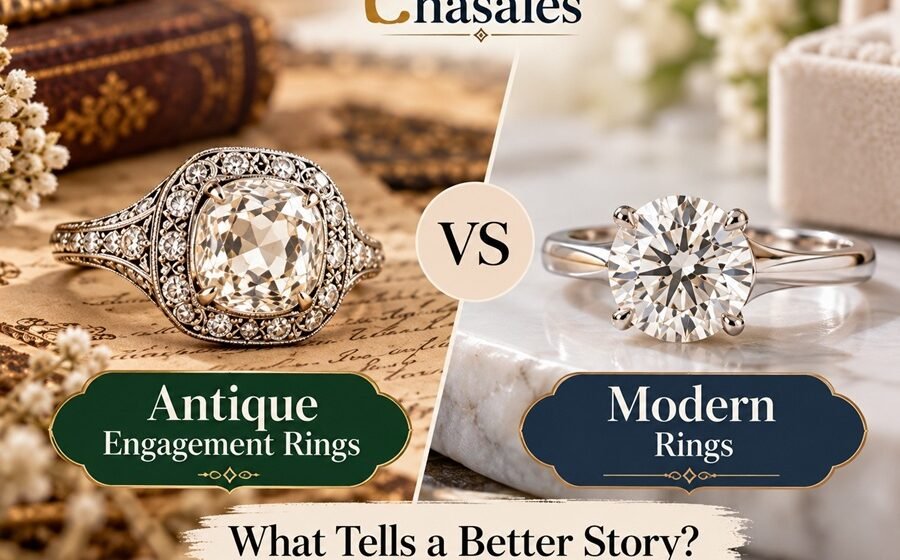

Quick answer: Antique rings offer history, rarity, and hand-crafted character. Modern rings offer new-condition durability, easy customisation, and a choice of sizes and settings. Neither is better for everyone. The right ring is the one that fits your lifestyle, budget, and the story you want to wear.
Choosing an engagement ring often comes down to one simple question: do you want a ring with a past, or a ring that starts its story with you?
Here is a clear, balanced guide to help you decide, with real pros and cons on both sides.
First, What Do “Antique”, “Vintage” and “Estate” Actually Mean?
These words are used loosely, which confuses many buyers. Here is the usual meaning:
- Antique: A piece is generally called antique if it is over 100 years old. This covers the Georgian (1714–1837), Victorian (1837–1901), and Edwardian (about 1901–1915) periods, plus early Art Nouveau and Art Deco pieces.
- Vintage: Younger than antique, and commonly described as roughly 20 to 100 years old. Think Art Deco, Retro, and mid-century styles.
- Estate: Simply means previously owned. It does not tell you how old the ring is.
- Vintage-inspired: A brand-new ring made to look old. It is not pre-owned. Many rings sold as “vintage” in big stores are actually of this type, sometimes using old-style cut diamonds in a newly made setting.
Tip: Dates vary slightly between sellers, and some rings are labelled antique when they are a little under 100 years old. Always ask for the exact age and how it was verified.
Antique Engagement Rings: Pros and Cons
Pros
- Real history: The ring has already lived a long life. If you love the idea of wearing a piece from the Victorian or Edwardian era, nothing modern can copy that.
- Hand craftsmanship: Antique rings often show hand engraving, filigree, and milgrain that are rare in mass production today.
- Unusual stone cuts: Many use old mine and old European cuts, which give a soft, warm glow. You can read more in our guide to old mine cushion cut diamonds.
- Rarity: You are unlikely to see anyone else wearing the same ring.
- Second life: Buying a ring that already exists gives it another chapter.
Cons
- More delicate: Older rings can be more fragile, so they need extra care. Wear and thin bands are common.
- Sizing and repairs can be tricky: Detailed or engraved bands may not resize easily, so ask a specialist before you buy.
- Limited choice: You choose from what exists. You cannot ask for a different stone size or metal.
- Condition varies: Small chips or repairs are possible. A trustworthy dealer will point them out.
- You need to do more checking: Age, authenticity, and condition need careful questions (see the checklist below).
Modern Engagement Rings: Pros and Cons
Pros
- Built for today: New settings and modern manufacturing usually mean strong, secure mounting.
- Customisable: You can often choose the stone, metal, band, and size.
- Easy to resize and repair: Most jewellers can work on them without worrying about old, fragile metal.
- Clear paperwork: New stones often come with grading reports and a clear ownership history.
- Wide choice of budgets: From simple solitaires to bespoke designs.
Cons
- Less individual history: No previous story, though you can start your own.
- Can look similar to others: Popular designs are made in large numbers.
- Brighter, more uniform sparkle: Some people love this, and others find it less romantic than a soft, hand-cut glow.
Side-by-Side Comparison
| Feature | Antique ring | Modern ring |
|---|---|---|
| Age | 100+ years | New |
| Story | Real, historical | You create it |
| Design | One of a kind, hand-crafted | Customisable, precise |
| Stone cuts | Old mine, old European, rose cut | Modern brilliant, cushion, oval, etc. |
| Durability | Needs more care | Usually stronger |
| Sizing | Can be tricky | Usually easy |
| Rarity | High | Depends on the design |
| Best for | History lovers, vintage style | Customising, everyday wear |
What About Vintage Rings? A Middle Path
If antique feels too delicate and modern feels too plain, a vintage ring (say, from the Art Deco or Retro era) could be a good middle ground. They often carry real character and craftsmanship, and many are sturdier for regular wear. Our guide to bezel-set engagement rings shows how the Deco style works in a practical everyday setting.
How to Decide: 5 Simple Questions
- How do you use your hands every day? If you work with them a lot, a modern ring or a sturdy vintage style may be safer.
- Does history matter to you? If yes, antique may be worth the extra care.
- Do you want to choose every detail? If yes, go modern or custom.
- How comfortable are you with regular checks? Antique rings benefit from yearly inspections.
- What does your partner love? Show pictures of both styles and see which one they return to.
Checklist Before Buying an Antique Ring
- Ask for the exact age or era, and how the seller confirmed it.
- Ask what has been repaired, replaced, or resized.
- Ask for a written description of the stone (measurements, colour, clarity, and condition).
- Get an independent valuation if the ring is expensive.
- Check the return policy before you pay.
- Buy from a reputable dealer who is happy to answer detailed questions.
- Get it insured and have the setting checked regularly.
For more on this, read our upcoming guide on spotting authentic period pieces.
When comparing an Edwardian-style ring with a modern design, the difference in character can be easy to notice. Antique rings often feel more delicate, detailed, and handcrafted, with features such as fine engraving and milgrain, while modern rings tend to focus more on everyday comfort, durability, and a cleaner finish. Trying both styles on the hand can also reveal differences in weight, profile, and how easily the ring fits into daily wear.
So, Which Tells a Better Story?
An antique ring tells a story that started long before you. A modern ring lets you write the first page yourself. Both can be beautiful, and both can last a lifetime with proper care.
The better story is the one that feels true to you and your partner.
Frequently Asked Questions
What is the difference between antique and vintage engagement rings?
Antique rings are generally over 100 years old. Vintage rings are younger, often around 20 to 100 years old, though sellers use slightly different cut-offs.
Are antique engagement rings good for everyday wear?
They can be, but they need more care than new rings. Ask a jeweller to check the setting and avoid heavy work while wearing it.
Are antique engagement rings more expensive than modern ones?
It depends on the stone, metal, maker, age, and condition. Compare several options instead of assuming either type costs more.
Can antique engagement rings be resized?
Often yes, but it depends on the design. Detailed or engraved bands may be harder to alter, so ask a specialist first.
What does “vintage-inspired” mean?
It means a new ring made to look old. It has not been owned before, and it is not an antique.
How do I know if an antique ring is real?
Ask for the era and how it was verified, look for a written description, and consider an independent valuation from a qualified gemmologist or antique jewellery specialist.
Is an antique or modern ring better for an engagement?
Neither is better for everyone. Choose based on your lifestyle, budget, and the style you love.
A Final Word from Chasale
At Chasale, we believe an engagement ring should feel like a choice you are proud of, not a decision you were rushed into. Whether you fall for a hundred-year-old antique or a freshly made modern design, ask questions, take your time, and trust what you love. For more clear, honest guides on jewellery and bridal style, keep reading Chasale.


[…] Antique Engagement Rings vs Modern Rings: What Tells a Better Story?by Aarav KashyapSeptember 30, 2026 […]
[…] Antique Engagement Rings vs Modern Rings: What Tells a Better Story?by Aarav KashyapSeptember 30, 2026 […]