







What Is a Magnifying Glass Used For?
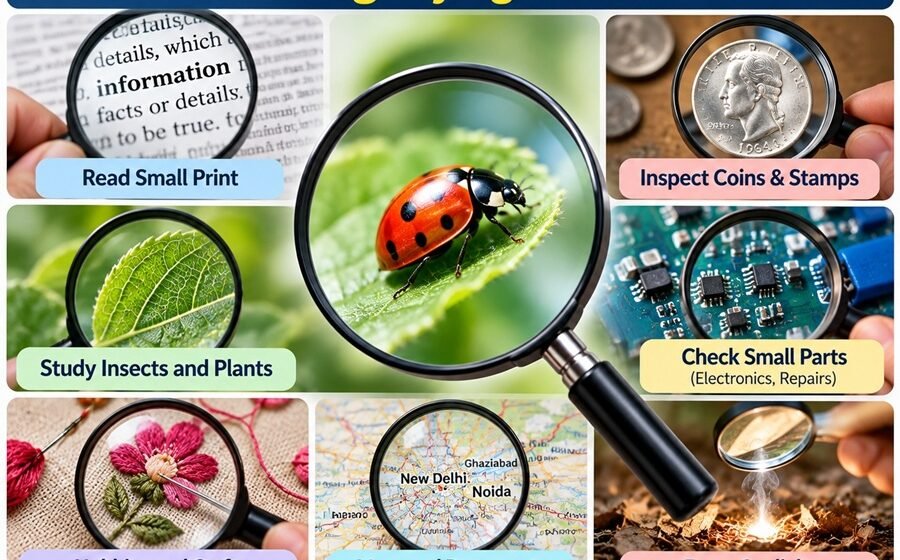
A magnifying glass is a convex lens that makes small objects look bigger. People use it to read fine print, inspect coins and stamps, study insects and leaves, check tiny electronic parts, and, in strong sunlight, to focus light into a bright hot spot.
Below, you will find the common uses, a simple explanation of how it works, its history, and a few safety tips.
Key Takeaways
| Question | Quick answer |
|---|---|
| What is it? | A convex lens that forms an enlarged, upright image |
| Main uses | Reading small print, hobbies, school science, close inspection |
| How does it work? | Hold the object inside the focal length. Refraction forms a magnified virtual image |
| Magnification formula | M = 1 + D/f (image at near point, D = 25 cm) |
| Who invented it? | No single inventor. Early written descriptions include Ibn al-Haytham (about 1021) and Roger Bacon (13th century). Verify before publishing |
| Can it improve eyesight? | It makes print look larger but does not correct vision |
| Key safety rule | Never look at the Sun through it, and don’t leave it in sunlight |
What Is a Magnifying Glass?
A magnifying glass is a lens that produces an enlarged image of an object. The lens is a convex (converging) lens, which means it is thicker in the middle than at the edges. It is usually made of glass or optical-grade plastic and mounted in a frame with a handle.
Define magnifying lens: a magnifying lens is a convex lens that, when held close to an object, forms an upright, enlarged image of it.
Magnifying glass vs. loupe vs. microscope
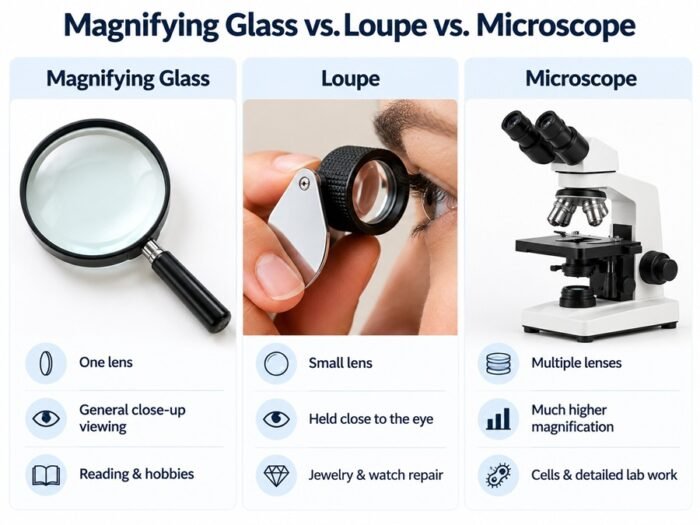
| Tool | How it works | Typical use |
|---|---|---|
| Magnifying glass | One lens, held at a distance from the eye | Reading, general close-up viewing, hobbies |
| Loupe | Small lens held very close to the eye | Jewellery, watch repair, close inspection |
| Microscope | Several lenses combined | Cells, microorganisms, detailed lab work |
A magnifying glass is the simplest form of a basic optical microscope. A real microscope reaches far higher magnification, but it needs more setup.
What Is a Magnifying Glass Used For?
Everyday uses
- Reading small print on medicine strips, labels, bills and maps
- Looking at a splinter or a tiny object on a surface
- Checking small text on documents
Hobbies and crafts
- Collecting and examining stamps and coins
- Embroidery, model-making and miniature painting
- Watch, jewellery and electronics repair
Science and school work
- Looking at insects, leaves, flowers, seeds and minerals
- Class experiments on light and lenses
- Observing fingerprint patterns, a classic school activity
Professional and industrial uses
In workshops and factories, magnifiers are used to check surface defects and small components such as solder joints on circuit boards. Professional versions are often built with lights and stands for long inspection work.
Starting a fire with sunlight
A magnifying glass can focus sunlight into a small, very hot spot. Under the right conditions it can ignite dry tinder. This is why the same tool is sometimes mentioned in survival guides. It is also why you should never leave one lying in the sun. See the safety tips below.
Can a Magnifying Glass Help Your Eyes?
People often search for “magnifying glass eye” when they want help reading small text. A handheld magnifier can make print look larger. This can be useful for people with low vision or age-related difficulty with close work (presbyopia).
However, a magnifier does not treat or correct your eyesight. It is not a replacement for prescription glasses. Please see an eye doctor if you notice:
- Sudden changes in your vision
- Eye pain, redness or flashes of light
- Increasing difficulty with close or distance vision
Sudden vision loss needs urgent medical attention.
How Does a Magnifying Glass Work? (Physics, Simply)
A convex lens bends light rays toward each other. This bending is called refraction. The point where parallel rays meet after passing through the lens is the focus, and the distance from the lens to that point is the focal length (f).
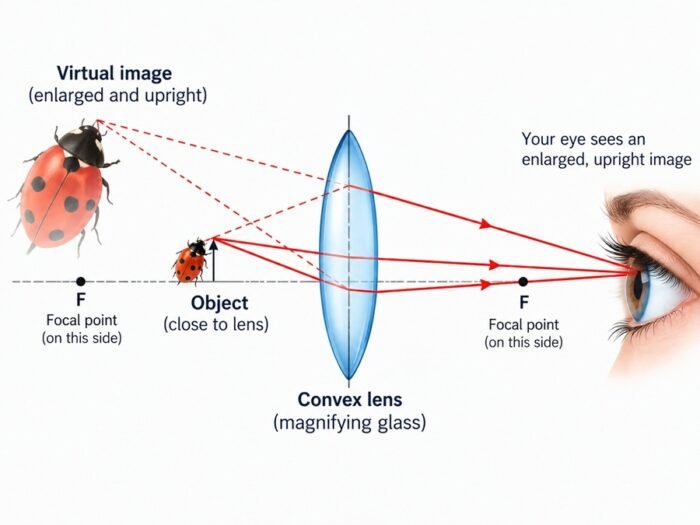
The magnifying effect happens when you hold the object closer to the lens than its focal length:
- Light from the object passes through the lens and bends.
- The rays spread apart after the lens instead of meeting.
- Your eye traces those rays backward and sees an enlarged, upright image on the same side as the object. Physicists call this a virtual image.
If you hold the object farther than the focal length, you no longer get this magnified, upright view. The image may appear inverted or blurred. That is why distance matters when using a magnifier.
A simple magnification example
A common school formula for a simple magnifier uses D, the “near point”, conventionally taken as 25 cm.
- When the image is formed at the near point: M = 1 + D/f
- When the eye is relaxed (image at infinity): M = D/f
Example: for a lens with f = 10 cm,
- M = 1 + 25/10 = 3.5x (image at near point)
- M = 25/10 = 2.5x (relaxed eye)
A lens with a shorter focal length magnifies more. Real near-point distance varies from person to person, so actual magnification is not identical for everyone.
Why high magnification gets blurry
As magnification increases, a simple lens shows optical flaws such as spherical aberration. The image becomes less sharp. For higher magnification or a better image, loupes or microscopes are used instead.
When Were Magnifying Glasses Invented?
No single person invented the magnifying glass. The technology developed gradually as people learned more about lenses, light, and vision.
- Ancient Greece and Rome: The use of curved transparent materials to concentrate sunlight was known in the ancient world. Aristophanes’ play The Clouds, dating to around 423–424 BC, contains an early reference to a transparent material used to focus sunlight and produce fire. Later Greek and Roman writers also described glass or water-filled vessels that could magnify objects or concentrate sunlight.
- 11th century: The Persian-Arab scholar Ibn al-Haytham (Alhazen) made major contributions to the scientific study of optics. His seven-volume Book of Optics (Kitab al-Manazir), written around the early 11th century, examined vision, light, reflection, refraction, and the way lenses can produce magnification. His work became an important foundation for later developments in European optics.
- 13th century: Roger Bacon continued the study of optics in Europe and investigated convex lenses, magnification, and their potential use as visual aids. His optical writings helped advance the understanding of lenses and magnification during the 13th century.
The modern handheld magnifying glass emerged from this longer development in optical technology rather than from a single invention by one person.
How to Choose and Use a Magnifying Glass
| Task | Suitable type | Limitation |
|---|---|---|
| Reading print | Handheld or stand magnifier | Handheld models can tire the hand |
| Long hobby work | Magnifying lamp or stand | Needs space and a power source |
| Fine detail work | Headband magnifier | Can feel heavy for long use |
| Jewellery or small objects | Loupe | Must be held very close |
| Occasional use, travel | Pocket or folding magnifier | Smaller field of view |
These are general guidelines. Check the product’s stated magnification before buying.
Practical tip: move the lens, not your eyes. If small print looks blurry, hold the magnifier close to the page. Then slowly lift it away until the text sharpens. The clearest upright view appears when the object sits just inside the lens’s focal length. Hold it too far away and the image turns upside down and blurs. Good lighting on the page also makes small print easier to read.
Common mistakes
- Holding the lens too far from the object
- Expecting a basic magnifier to perform like a microscope
- Using it in dim light without extra lighting
- Buying only by “x” number without checking lens quality
Safety tips
- Never look at the Sun through a magnifying glass or any lens.
- Do not leave it where sunlight can pass through onto paper, fabric or wood.
- Keep it away from small children unsupervised.
- Store it in a case to avoid scratches on the lens.
Pros and cons at a glance
| Pros | Cons |
|---|---|
| Simple to use, with no learning curve | Limited magnification compared with a microscope |
| Needs no power or batteries (except lighted models) | Image blurs or distorts at higher magnification |
| Portable and easy to store | A handheld model can tire the hand |
| Useful for reading, hobbies and school work | Not a substitute for prescription glasses |
| Many types for different tasks | Can start a fire if left in direct sunlight |
FAQs
Is a magnifying glass a convex or concave lens?
It is a convex lens. A concave lens spreads light and makes objects look smaller.
Can a magnifying glass burn paper?
Yes, in strong direct sunlight a magnifying glass can focus enough heat to burn dry material. Use it carefully and never leave it unattended in the sun.
What is the difference between a magnifying glass and a microscope?
A magnifying glass uses a single lens and gives modest magnification. A microscope uses multiple lenses for much higher magnification.
Does a magnifying glass improve eyesight?
No. It makes things look larger, but it does not correct or heal vision problems. See an eye doctor for eye concerns.
Who invented the magnifying glass?
No one person. Lens use developed over centuries, with important written descriptions by Ibn al-Haytham (around 1021) and Roger Bacon (13th century). Verify before publishing.
How do I calculate magnification?
For a simple magnifier with the image at the near point, use M = 1 + 25/f, where f is in centimetres.
Must Read: 10 Simple Ways to Stay Motivated When Life Feels Difficult


[…] What Is a Magnifying Glass Used For? Uses, Working & Historyby Aarav KashyapOctober 7, 2026 […]