







What Is the Indian Legend Regarding the Discovery of Tea? The Bodhidharma Story, Explained

What Is the Indian Legend Regarding the Discovery of Tea?
Short answer: The Indian legend of tea’s discovery is the story of Bodhidharma, a monk traditionally described as a South Indian prince who carried Buddhism to China. After falling asleep during nine years of meditation, he is said to have cut off his eyelids in anger. Where they hit the ground, the first tea plants grew. The monk is Indian, but the story is set in China and survives mainly in Chinese and Japanese Zen lore. It is a legend, not recorded history.
Search for this legend and most pages give you the same eyelid story, then drift into a generic timeline of tea. Three questions usually go unanswered. Why is it called Indian when it happens in China? Where does the story actually come from? And what about the tea that grew wild in India long before any legend was written down?
This post answers all three, and separates what is folklore from what is documented.
What does the Bodhidharma tea legend say?
Bodhidharma, the monk credited with founding Chan Buddhism (known as Zen in Japan), vows to meditate facing a wall for nine years without sleeping. Somewhere along the way, exhaustion wins. He wakes, furious at himself, and cuts off his own eyelids so he can never close his eyes again. He flings them to the ground.
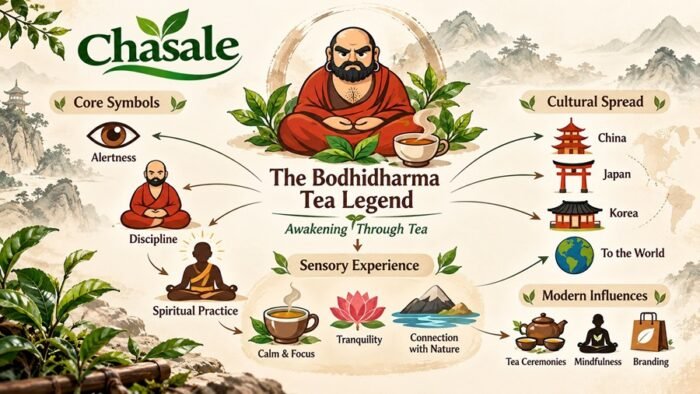
Where they land, a plant sprouts. Its leaves, steeped in hot water, drive off sleepiness. The monk and his followers drink it, and tea is born.
Tellings vary. In some, Bodhidharma simply chews wild leaves to stay awake. Others swap in the Buddha himself as the sleepy meditator. The details change, but the point stays the same: tea is the plant that keeps a seeker alert.
Why is it called an Indian legend if it happens in China?
Because of who the hero is. Chinese texts from the 6th century onward describe Bodhidharma as a South Indian. The monk Tanlin called him the third son of a great Indian king, and later tradition places him in the Pallava royal family of Kanchipuram, in present-day Tamil Nadu.
The picture gets messier the closer you look. The earliest text to mention him, Yang Xuanzhi’s Record of the Buddhist Monasteries of Luoyang (547), calls him a Persian from the Western Regions, and many Japanese traditions still draw him as a red-haired foreigner. The scholar John McRae argues that no reliable biography can be rebuilt from the sources, and some researchers even suggest he may not have been a single historical person. The famous link between Bodhidharma and Shaolin martial arts is a 20th-century development, not an ancient one.
So “Indian legend” is shorthand for an Indian protagonist on a Chinese stage, retold in Japan. It does not mean the story started in India.
Where does the eyelid-and-tea story come from?
The earliest sources are not the ones people assume. The “nine years facing a wall” detail first appears in a Chinese collection from 952, the Anthology of the Patriarchal Hall. The eyelid-and-tea tale came later, and reference works usually describe it as a Japanese legend. I could not find a firm date or author for its first written version, and none of the sources I checked offers one, so be wary of any site that states one confidently.
What the story does reflect is something real. Zen monks did drink strong tea to stay awake through long meditation. In 1191 the Japanese priest Eisai brought tea seeds home from China, and in 1211 he wrote Kissa Yojoki (“How to Stay Healthy by Drinking Tea”), which opens by calling tea the ultimate mental and medical remedy. The legend works like a creation story told backwards: a real habit explained through a dramatic origin.
One common claim is worth correcting. You will read that the Japanese Daruma doll has no eyelids because of this tale. In fact, Daruma dolls are sold with blank eyes so the owner can paint one in when setting a goal and the other when it is achieved. The doll’s missing limbs come from a separate legend, that Bodhidharma sat so long his legs withered. The eyelid story is not part of the doll’s tradition.
How does the legend compare with other tea origin stories?
| Story | Who and where | What happens | What it really tells us |
| Shennong legend | Emperor Shennong, China, dated to about 2737 BCE in tradition | Leaves blow into his pot of boiled water and he tastes the first cup | Tea was first valued as medicine. The date is legendary, not archaeological. |
| Bodhidharma legend | Indian monk, Shaolin in China, retold in Japan | His cut eyelids grow into tea bushes | Tea’s long bond with Zen discipline and staying awake |
| Assam discovery | Robert Bruce, the Singpho people and Maniram Dewan, Assam, 1823 | A Scottish trader is shown tea that locals already grow | Documented history: wild tea existed in India before the British plantations |
Hard evidence points elsewhere than any legend. Tea remains found in the tomb of Emperor Jing of Han in Xi’an, reported in Nature in 2016, show Han emperors were drinking tea by the 2nd century BCE. Botanists think Camellia sinensis first grew in the borderlands of southwest China and northern Myanmar, which helps explain why wild tea also turned up in Assam.
What is the documented story of tea discovery in India?
This is the part most legend pages skip, and it is the one with names, dates and a twist.
In 1823, a Scottish trader named Robert Bruce was at Garhgaon in Assam when he met a Singpho chief, Bisa Gam (spelled Bessa Gaum in some records). The Singpho people were already growing tea. Bruce learned of it from Maniram Dewan, an Assamese nobleman, who pointed the Bruce brothers toward the chief. Bruce’s brother, Charles Alexander Bruce, later collected plants and took them to the Company administration. Robert died in 1824, so he never saw what followed.
Large-scale planting began with the Assam Company in 1839, and Maniram Dewan became its dewan at Nazira. He later left, and in the mid-1840s founded his own garden at Cinnamara near Jorhat, making him the first Indian to grow tea commercially in Assam. In 1857 he was accused of plotting with others against British rule during the uprising, and he was hanged at Jorhat on 26 February 1858.
So when a page says the British “discovered” Assam tea, a better description is that they were introduced to a plant local communities already knew, then built an industry on it. That is a far more interesting origin story than a legend about eyelids.
Where does Bodhidharma live on in India today?
Mainly in Tamil Nadu, where the Kanchipuram and Pallava connection is a point of regional pride. Keep in mind that this link is tradition, and the scholarly case for Kanchipuram rests on a speculative reading of one Chinese term.
The 2011 Tamil film 7 Aum Arivu, starring Suriya, introduced Bodhidharma to a mass audience as a martial-arts master and healer. It also drew criticism for historical inaccuracies, including the monk’s age on arriving in China. Whatever the film’s accuracy, it shows that the “Indian” in this legend is still alive as culture, not just a footnote.
What does the legend really teach?
The eyelid story is not trying to explain botany. It ties tea to attention. Seen that way, a plant that grew from sacrifice and discipline becomes a fitting drink for monks, and later for the Japanese tea ceremony, which grew out of Zen temples. If you remember one thing, make it this: the legend explains why tea mattered to meditators, while the Assam record explains how tea came to India.
Frequently Asked Questions
Is the Indian legend of tea discovery true?
No. It is a folk legend about Bodhidharma, and no historical record supports the eyelid story. It reflects a real practice, Zen monks drinking tea to stay awake.
Was Bodhidharma Indian or Chinese?
Chinese texts from the 6th century onward call him a South Indian prince, though the earliest mention (547) calls him a Persian from the Western Regions. Scholars say a reliable biography cannot be reconstructed.
Who discovered tea according to Chinese legend?
Emperor Shennong, around 2737 BCE in tradition, when leaves blew into his boiling water. The date is legendary, not archaeological.
Who discovered tea in India?
Tea grew wild in Assam and was already used by the Singpho people. Robert Bruce was shown the plant in 1823, with help from Maniram Dewan, and large-scale plantations followed with the Assam Company in 1839.
Where did tea originate?
Botanists think the tea plant first grew in the borderlands of southwest China and northern Myanmar. The oldest physical evidence of drinking tea comes from a Han dynasty tomb in Xi’an, dated to the 2nd century BCE.
Why does the legend use eyelids?
Because the story explains tea’s effect on sleep. If tea keeps you awake, the tale suggests it must have grown from the part of the body that closes in sleep.
Sources used
- Wikipedia, Bodhidharma: https://en.wikipedia.org/wiki/Bodhidharma
- Wikipedia, History of tea: https://en.wikipedia.org/wiki/History_of_tea
- Wikipedia, Robert Bruce (trader): https://en.wikipedia.org/wiki/Robert_Bruce_(trader)
- Wikipedia, Maniram Dewan: https://en.wikipedia.org/wiki/Maniram_Dewan
- Wikipedia, Daruma doll: https://en.wikipedia.org/wiki/Daruma_doll
- Lafayette College exhibit, The Man with no Eyelids: https://exhibits.lafayette.edu/s/mate/page/spiritualitea-2
- Britannica, Bodhidharma: https://www.britannica.com/biography/Bodhidharma
- Lu et al., Nature (2016), tea remains in the tomb of Emperor Jing of Han
Must Read: How to Choose the Right Camper Hitch for Your Adventures (2026 Guide)


[…] What Is the Indian Legend Regarding the Discovery of Tea? The Bodhidharma Story, Explainedby Aarav KashyapOctober 16, 2026 […]