






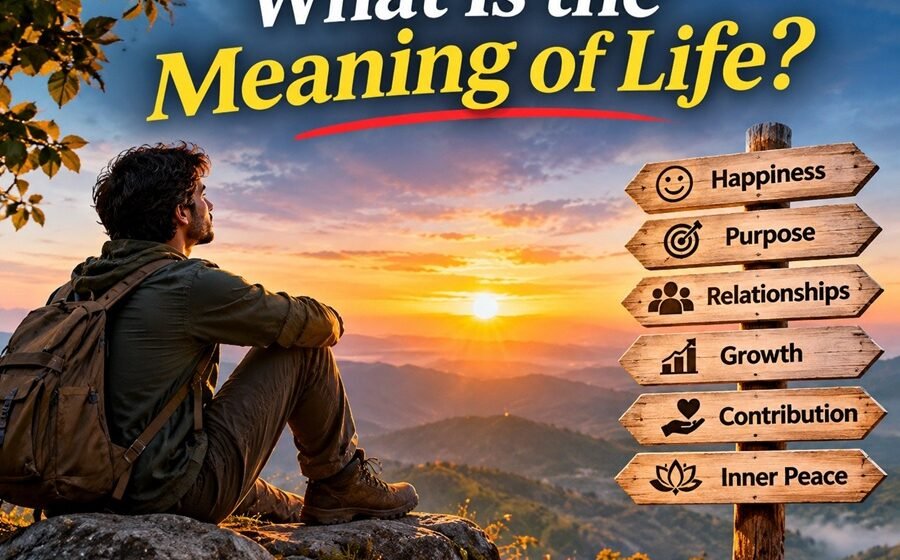
What Is the Meaning of Life? What Science, Philosophy and the Number 42 Actually Tell Us

Quick Answer: There is no single proven meaning of life. Philosophers split into three camps: meaning given by God, meaning found in things that matter objectively, and meaning we create ourselves. Research is clearer about where people actually find it. When Pew Research Center asked nearly 19,000 adults in 17 countries, family was the most-cited source of meaning, and roughly half or more of Americans named it. (And “42”? That was Douglas Adams’ joke.)
It usually shows up at odd hours. You’re driving home from a job you don’t love, or sitting in a hospital waiting room, or blowing out candles on a birthday that ends in zero. And there it is: what is the meaning of life, and is mine adding up to anything?
You’re in good company. Philosophers have argued about this for 2,500 years, and researchers now survey thousands of people about it. This guide pulls both together, explains the famous “42” answer, and ends with a 10-minute exercise you can do tonight.
Why “What Is the Meaning of Life?” Is Harder Than It Sounds
Part of the trouble is that one question hides two. The first is about the meaning of life: does human existence as a whole have a point? The second is about meaning in life: is my life meaningful, and what would make it more so?
Philosophers keep these apart. Most of today’s academic work, as the Stanford Encyclopedia of Philosophy explains, focuses on the second question, because it’s the one we can actually do something about.
When people ask “what is the meaning of life,” they usually mean one of three things:
- “What does the question even mean?” (purpose, significance, or making sense of things?)
- “What is the meaning of my life?” (what should I build my life around?)
- “Is my life meaningful right now?” (am I on track?)
We’ll take them in that order. But first, the answer half the internet gives you.
What Is the Meaning of Life, the Universe and Everything? The Story of 42
If you searched “what is the meaning of life, the universe and everything,” you’re quoting Douglas Adams. In The Hitchhiker’s Guide to the Galaxy (a BBC radio series in 1978, then a novel in 1979), a race of super-intelligent beings builds a computer called Deep Thought to find the Answer to the Ultimate Question of Life, the Universe, and Everything.
Deep Thought works on it for 7.5 million years. Its answer: forty-two.
Fans have spent decades decoding it. Is it a binary pattern? A base-13 math trick, since the books link 42 to six times nine? Adams shut those theories down himself. In a 1993 post to a fan newsgroup, he said it was a joke: he needed an ordinary, smallish number, and picked that one. On the base-13 idea, he said he didn’t write jokes in base 13.
Here’s why the joke still lands. In the story, the answer is useless because nobody knows what the question actually was. That’s the most practical lesson in this whole article: a vague question gets a vague answer. “What is the meaning of life?” is too big to act on. “What do I want my next five years to be about?” is not.
Keep that in mind. You’ll use it in the exercise later.
Three Big Answers From Philosophy
Leo Tolstoy had fame, money, a family and two of the greatest novels ever written. Then, around age 50, he fell into a crisis so deep that he described it in A Confession: none of it seemed to mean anything. His story shows the question isn’t only for people who are struggling. Success doesn’t settle it.
Philosophers have offered three main kinds of answers.
1. Meaning comes from God or a soul. On this view, life matters because it’s part of a divine plan, or because your soul continues beyond this life. Most of the world’s religions hold some version of it. The strength: meaning doesn’t depend on your mood or your achievements. The common objection: it only persuades people who already share the belief.
2. Meaning comes from things that matter objectively. Here, some pursuits are meaningful whether or not you feel it: loving people well, discovering truth, creating beauty, easing suffering. A nurse working a night shift is doing something meaningful even on a night she feels nothing but tired.
3. Meaning is what you choose and care about. Subjective views say meaning comes from pursuing what you personally value. The risk is obvious: someone could find deep meaning in counting blades of grass.
Many philosophers now land on a blend. Philosopher Susan Wolf argues that meaning arises when you’re actively engaged with something that is genuinely worthwhile, so both your feelings and the thing itself count.
| View | Core claim | Main objection |
|---|---|---|
| God or soul-based | Life matters as part of a divine purpose | Depends on faith not everyone shares |
| Objective | Some activities are meaningful no matter how you feel | Who decides what counts? |
| Subjective | Meaning is whatever you value and pursue | Makes trivial pursuits “meaningful” too |
| Hybrid (Wolf) | Engagement plus genuine worth | Still needs a standard for “worth” |
There’s also a fourth position: nihilism, the view that life has no meaning at all. Albert Camus took it seriously in The Myth of Sisyphus (1942). His surprising conclusion wasn’t despair. He pictured Sisyphus, endlessly rolling his boulder uphill, and argued we must imagine him happy. In other words, you can find life worth living even without a cosmic answer.
What Eastern Traditions Add
Most Western articles on the meaning of life stop at Europe. That leaves out ideas that many Americans already use, often without knowing where they came from.
- Buddhism starts from the observation that life involves suffering, and teaches a path to ease it. Meaning, in this tradition, comes from waking up to how things are and practicing compassion. Many U.S. mindfulness programs grew out of these teachings.
- Hindu thought describes four aims of a full life: dharma (duty and right action), artha (livelihood), kama (love and pleasure) and moksha (liberation). The Bhagavad Gita adds a striking idea: do your work well, but don’t cling to its results. It’s an old answer to modern burnout.
- Japanese ikigai roughly means “a reason for being” or “a life worth living.” In everyday Japanese use, it’s often small and close to home: tending a garden, caring for grandchildren, being good at your job. It doesn’t have to be a grand mission.
What these traditions share is useful: meaning is something you practice daily, not a single answer you find once.
Where Americans Actually Find Meaning: What the Research Says
Philosophy asks what should give life meaning. Surveys ask what does. In 2021, Pew Research Center asked nearly 19,000 adults in 17 advanced economies an open-ended question: what about your life do you currently find meaningful, fulfilling or satisfying? In the U.S., 2,596 adults answered in February 2021.
The results were remarkably consistent:
- Family came first. It was the top answer in 14 of the 17 places surveyed. Across all of them, a median of 38% mentioned family, and in the U.S., roughly half or more did.
- Work varies a lot by culture. In Italy, 43% mentioned their job or career. In South Korea, just 6% did, according to a Greater Good Science Center summary. Americans fell in between, naming careers far less often than family.
- Ordinary security matters. Many answers were about material well-being: food on the table, a roof overhead, a decent income to support family.
The specific examples people gave are telling. Pew describes a cybersecurity worker who finds meaning in seeing his work used in practice, and a teacher who loves helping kids understand history. Neither is changing the world. Both feel their effort lands somewhere.
A quick self-check based on this research: which of these did you think of first when you read the question?
- Family or close relationships
- Work or a skill I’m proud of
- Financial stability and a secure home
- Friends and community
- Faith or spirituality
- Health
Keep your answer. It’s the starting point for the Chasale Meaning Audit below.
One caveat: this data was collected during the COVID-19 pandemic, which may have pushed family and health higher than usual.
Why a Sense of Meaning Matters for Your Health
Meaning sounds abstract, but researchers have found it shows up in health data too.
The U.S. study. University of Michigan researchers looked at nearly 7,000 American adults aged 51 to 61 from the national Health and Retirement Study, published in JAMA Network Open in 2019. Participants filled out a standard questionnaire measuring purpose in life. Over the following years, those with the lowest purpose scores were more than twice as likely to die as those with the highest, especially from heart and circulatory conditions. The link held after accounting for income, gender, race and education.
The Japanese study. The Ohsaki study followed 43,391 adults for seven years and asked a simple question: do you have ikigai in your life? About 59% said yes, 36.4% weren’t sure and 4.6% said no. People without ikigai had about 1.5 times the risk of dying during the study, mainly from cardiovascular disease and external causes, not cancer.
Beyond the individual. A 2021 review in Frontiers in Psychology links a sense of meaning with stronger social ties, more volunteering, better coping in crises and even gains in household income over time.
An important caution: these studies show associations, not proof of cause. People who feel purposeful may also sleep better, exercise more or have more support around them. Still, the study authors themselves note that purpose may be something people can strengthen, which makes it worth paying attention to.
Meaning vs. Happiness vs. Purpose: What’s the Difference?
These three words get used interchangeably, but they aren’t the same thing.
| Happiness | Purpose | Meaning | |
|---|---|---|---|
| What it is | Feeling good right now | A direction or goal you’re working toward | The sense that your life matters and makes sense |
| How long it lasts | Minutes to days | Until the goal changes | Builds over a lifetime |
| Everyday example | A great dinner with friends | Training for a marathon | Raising a child, even on exhausting days |
The last row explains something many people feel but rarely say: a meaningful life isn’t always a happy one. Caring for a parent with dementia can be draining and sad, yet many caregivers describe it as one of the most meaningful things they’ve done. Meaning can hold hard feelings that happiness can’t.
How the Meaning of Life Changes From 18 to 65
The question stays the same, but the answer usually shifts with each stage of adult life.
Ages 18 to 29: “Who am I, and what am I for?”
This is the exploring stage. You might be choosing a major, starting a first job or comparing your life to highlight reels on social media. The trap is thinking you need one big calling by 25. Most people don’t have one. Meaning at this age often comes from learning, trying things and building close friendships, which are the relationships that research keeps linking to a sense of meaning.
Example: a 24-year-old who hates her entry-level marketing job but loves the one weekend a month she volunteers at an animal shelter. That’s not a failure to find meaning. It’s data about where hers lives.
Ages 30 to 49: The goal trap
Career and family pressure peak here. So does a quiet problem: when you reach a goal you’ve chased for years (the promotion, the house, the degree), the satisfaction often fades fast. Elite athletes show this clearly. Michael Phelps, the most decorated Olympian in history, has spoken openly about depression after his Olympic runs ended.
The fix isn’t to stop setting goals. It’s to tie each goal to a reason bigger than itself. “Get promoted” fades. “Build a team where people actually like coming to work” keeps going.
Ages 50 to 65: Legacy and the retirement cliff
Kids leave home, careers wind down and some long-standing sources of meaning start to fall away. Researchers note that later life offers fewer new opportunities for meaning while removing some old ones. This is also the age group in the U.S. purpose study above, where low purpose was linked to higher mortality.
The people who handle this stage well usually plan for meaning the way they plan for money: mentoring younger colleagues, volunteering, deepening a craft or becoming the steady presence for grandchildren.
The Chasale 10-Minute Meaning Audit
You don’t need to solve the meaning of life tonight. You need a better question and one small next step. Grab a pen and set a timer for 10 minutes.
- Write your real question (2 minutes). Remember 42: a vague question gets a useless answer. Swap “What is the meaning of life?” for something you can act on, like “What do I want more of this year?” or “Who do I want to show up for?”
- Score five areas from 1 to 5 (3 minutes). Be honest, not aspirational.
- Relationships: Do I feel close to at least a few people?
- Work or craft: Does what I do all day feel useful to someone?
- Growth: Am I learning anything new?
- Service: Have I helped someone without being asked lately?
- Faith or wonder: Do I feel connected to something larger than myself, whether that’s God, nature or a cause?
- List three people you’ve helped in the past year (2 minutes). A coworker you trained, a friend you drove to an appointment, a neighbor’s kid you encouraged. Most of us underestimate the effect we have on others. This list is evidence.
- Circle your lowest score and pick one 15-minute action (2 minutes). Low on relationships? Text one old friend tonight. Low on service? Sign up for one volunteer shift. Keep it small enough that you’ll actually do it.
- Set a 30-day reminder (1 minute). Redo the scores in a month and compare.
The goal isn’t a perfect 25 out of 25. It’s noticing which part of your life is asking for attention.
When Life Feels Meaningless
Feeling that life has no point is more common than people admit, especially during big transitions: a breakup, a layoff, graduation, retirement, the loss of someone close.
Viktor Frankl, a psychiatrist who survived Nazi concentration camps, wrote about this in Man’s Search for Meaning (1946). He observed that prisoners who held on to something to live for, such as a loved one or unfinished work, were often better able to endure. His later therapy approach, logotherapy, was built on helping people find meaning even in suffering.
Sometimes, though, the feeling isn’t a philosophical question. It can be a sign of depression. Talk to a doctor or licensed therapist if, for two weeks or more, you notice:
- Hopelessness that doesn’t lift
- Losing interest in things you used to enjoy
- Big changes in sleep or appetite
- Pulling away from people
- Thoughts that others would be better off without you
If you’re in crisis or thinking about suicide, you don’t have to figure this out alone. In the U.S., you can call or text 988, or chat at 988lifeline.org, to reach the 988 Suicide & Crisis Lifeline. It’s free, confidential and available 24/7. If someone’s life is in immediate danger, call 911.
Frequently Asked Questions
What is the meaning of life, the universe and everything?
In Douglas Adams’ The Hitchhiker’s Guide to the Galaxy, a supercomputer spends 7.5 million years calculating the answer and declares it to be 42. Adams later admitted the number was a joke he chose because it was ordinary. The deeper point of the scene is that an answer is worthless if you don’t understand your own question.
Is there a scientific answer to the meaning of life?
Not in the sense of a cosmic purpose science can prove. What science can do is measure where people report finding meaning and how that connects to wellbeing. Large studies link a strong sense of purpose with lower mortality, though they show correlation rather than cause.
What is the difference between the meaning of life and meaning in life?
The meaning of life asks whether human existence as a whole has a point. Meaning in life asks whether one person’s life feels significant and worthwhile. Philosophers mostly study the second, because individuals can actually work on it.
Can life be meaningful without religion?
Many religious people find meaning in God’s purpose and the hope of an afterlife. Many secular people find it in relationships, work, creativity and service. Philosophers defend both positions, and this article doesn’t pick a winner.
Why do I feel like my life has no meaning?
It’s common during transitions like job changes, breakups or retirement, when old routines and roles disappear. If the feeling lasts two weeks or more, or comes with hopelessness, talk to a doctor or therapist. In a crisis in the U.S., call or text 988.
How can I find meaning in my life today?
Start small. Pick the area of your life that feels most neglected, such as relationships, work, growth, service or faith, and take one 15-minute action in it this week. Meaning tends to build from repeated small actions, not one sudden discovery.
The Bottom Line
Nobody has a proof for the meaning of life, and the most famous answer is a joke about a number. But the joke points somewhere useful. Ask a smaller, sharper question, and meaning gets much easier to find. For most people, the research says, it lives in close relationships, useful work and helping others, built a little at a time.
Try the Chasale 10-Minute Meaning Audit this week, then come back in 30 days and see what moved. For more on building a healthier, more grounded life, explore the wellbeing guides on Chasale.
Disclaimer: This article is for general education only. It is not medical, psychological or religious advice. If you’re struggling with your mental health, please speak with a licensed professional.
How this article was created: Our team researched this article using published studies and reference works, drafted it with the help of AI tools, then reviewed, edited and fact-checked every claim against the sources linked below.
About the author: Angel Mathew, B.Sc Nursing, B.PHM, writes about health and wellbeing for Chasale.
