








Quick Answer
How do you start investment in mutual funds? Investment in mutual funds in India takes four steps: complete a one-time KYC, choose a direct or regular plan, pick a fund category that matches your goal’s time horizon, and start a SIP or a lump sum. Many large fund houses accept SIPs from ₹100 a month. Returns are not guaranteed, and equity fund gains are taxed at 20% (12 months or less) or 12.5% above ₹1.25 lakh a year (over 12 months).
In October 2026 alone, Indians put ₹32,160 crore into SIPs through nearly 10 crore SIP accounts (AMFI data via EquityBulls).
Your salary lands, the FD rate looks tiny, and every app on your phone is telling you to “start a SIP today.” The hard part is not finding a place to invest. It is knowing what you are actually buying, what it costs you every year, and how the tax works when you sell.
If you have been searching for how to invest in mutual funds without the sales pitch, this guide walks you through investment in mutual funds from zero: the KYC, the plan you choose, the costs hidden in the fine print, the 2026 tax rules and the red flags that cost beginners real money. Chasale does not sell funds or earn commissions, so you will not find a “top 5 funds to buy” list here. You will find the method to judge any fund yourself.
What a Mutual Fund Actually Is (in Plain Rupees)
A mutual fund collects money from thousands of investors and a professional fund manager invests it in shares, bonds or both. You do not own the shares directly. You own units of the fund, and each unit carries a slice of everything the fund holds.
Think of it like a cricket team’s equipment fund. Eleven players each chip in ₹1,000, and the captain buys bats, pads and balls for the whole team. No single player could afford the full kit, but together they own all of it. A mutual fund works the same way, only the “kit” is a basket of 50 or 500 investments.
The price of one unit is called NAV (Net Asset Value). It is calculated at the end of every business day.
A quick example: You invest ₹5,000 when the NAV is ₹25. You get 200 units. A year later the NAV is ₹27.50, so your 200 units are now worth ₹5,500. If the NAV falls to ₹22.50 instead, they are worth ₹4,500. The number of units stays the same. Only their price moves.
Three players run the show:
- The AMC (Asset Management Company): the fund house that creates and runs the scheme.
- The fund manager: the person or team picking the investments.
- SEBI: the market regulator that sets the rules every fund in India must follow.
Before You Invest: Three Questions to Answer First
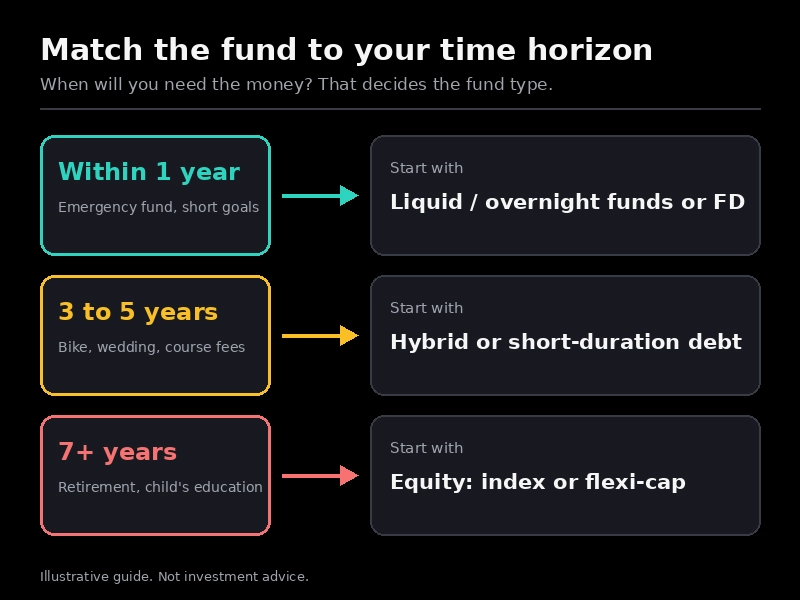
Most bad fund choices start before the app is even opened. Answer these three questions on paper first.
1. What is this money for, and when will you need it?
Your time horizon decides the type of fund far more than any “top performer” list does.
| When you need the money | Sensible starting point | Why |
| Within 1 year | Liquid or overnight debt funds, or an FD | Equity can fall 20% or more in a bad year, with no time to recover |
| 3 to 5 years | Hybrid or short-duration debt funds | Some growth, with smaller swings |
| 7 years or more | Equity funds, such as an index fund or flexi-cap fund | Enough time to ride out market falls |
2. Do you have an emergency fund?
Keep three to six months of expenses in a savings account or liquid fund before you start an equity SIP. Without it, a medical bill or job loss forces you to sell your equity fund at the worst possible time.
3. How would you feel if ₹1 lakh became ₹70,000 for a few months?
If the honest answer is “I would sell everything,” start with a hybrid fund or a smaller equity amount. A plan you can stick with beats a “better” plan you abandon during the first crash.
Investment in mutual funds by time horizon: liquid funds within 1 year, hybrid funds for 3 to 5 years, equity funds for 7+ years
How to Make Your First Investment in Mutual Funds: 5 Steps
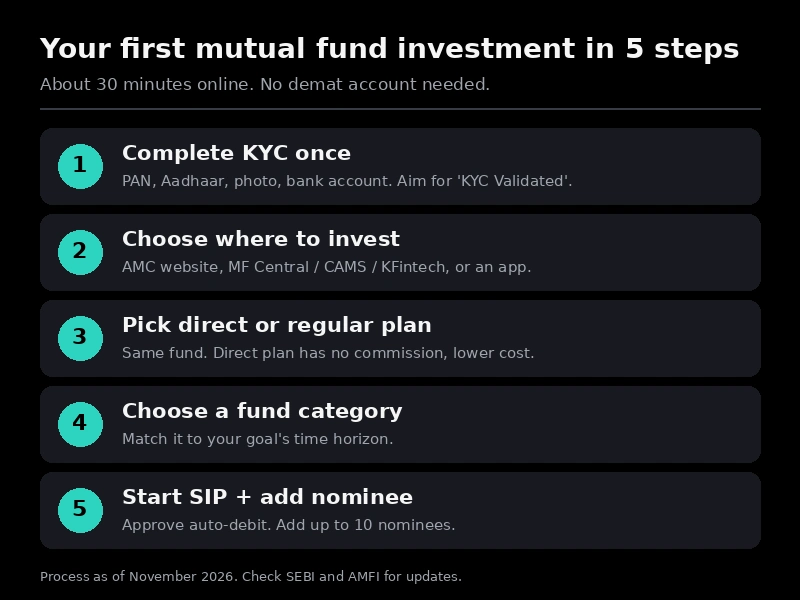
The whole process takes about 30 minutes online if your PAN, Aadhaar and bank details are ready. You do not need a demat account to invest in mutual funds.
Step 1: Complete your KYC once
KYC (Know Your Customer) is mandatory before your first investment. It is a one-time process. Once a SEBI-registered KYC Registration Agency (KRA) has your record, you do not repeat it for each new fund house (Aditya Birla Sun Life MF investor education).
You will need your PAN, Aadhaar or another address proof, a photo and a bank account in your name. After submitting, check your status on any KRA website. Aim for “KYC Validated”, which means your PAN and Aadhaar have been confirmed by the issuing authority, so you can invest in any fund without repeating the process (Business Standard).
Step 2: Choose where to invest from
You have three routes:
- The AMC’s own website or app: direct plans, but you manage each fund house separately.
- Registrar platforms (MF Central, CAMS, KFintech): one login to see and manage funds across fund houses.
- Investment apps or a distributor: convenient, but check whether they offer direct or regular plans before you start.
Step 3: Pick direct or regular plan
Every fund comes in two versions that hold exactly the same investments:
- Direct plan: you buy straight from the fund house. No commission, so a lower expense ratio.
- Regular plan: bought through a distributor, who earns a commission from your money every year.
If you are happy choosing funds yourself, a direct plan is usually cheaper. A regular plan can make sense if you value hand-holding from a distributor you trust. Just know what you are paying for (see the cost example below).
Step 4: Choose a fund category that fits your goal
Match the category to the time horizon from the table above. Most beginners with a 7-year-plus goal start with one broad equity fund, such as a Nifty 50 or Nifty 100 index fund or a flexi-cap fund, instead of buying five funds at once.
Step 5: Set up the SIP and add a nominee
Pick the SIP amount and date, then approve the auto-debit mandate (UPI AutoPay or e-mandate) from your bank.
Many large fund houses now accept SIPs from ₹100 a month (Business Standard). If you have never invested in any mutual fund before, look for a Chhoti SIP: a ₹250 SIP for first-time investors, allowed in up to three fund houses, which you can stop early without restriction (HDFC Mutual Fund).
Finally, add a nominee. SEBI now lets you name up to 10 nominees per folio and set each one’s percentage share (Business Today). It takes two minutes and saves your family months of paperwork.
5 steps for a first investment in mutual funds: KYC, platform, direct or regular plan, fund category, SIP and nominee
Reading a Fund Before You Buy: Riskometer, Expense Ratio and Exit Load
Three numbers on every fund’s page tell you more than its last-year return. Check them before you invest a single rupee.
The riskometer
Every scheme shows a SEBI-mandated riskometer, a speedometer-style dial with six levels: Low, Low to Moderate, Moderate, Moderately High, High and Very High. The reading is based on what the fund holds and is reviewed every month (Tata Mutual Fund).
Do not be surprised when most equity funds, even large-cap index funds, show High or Very High. That label is honest: equity prices swing a lot in the short term. The question is whether your time horizon is long enough to live with it.
The expense ratio
The expense ratio is the yearly fee, taken quietly out of the fund’s value. You never see a bill, which is exactly why it is easy to ignore.
Here is what a 1 percentage point difference does to a ₹5,000 monthly SIP over 20 years (₹12 lakh invested in total):
| Return after costs (assumed) | Value after 20 years |
| 11% a year | about ₹40.8 lakh |
| 10% a year | about ₹36.2 lakh |
| Gap | about ₹4.6 lakh |
These returns are assumptions for illustration, not a forecast. Actual returns vary and can be negative in some years. The point is the gap: a small yearly fee compounds into a big amount.
When comparing two similar funds, the one with the lower expense ratio starts with a head start every single year.
The exit load
An exit load is a fee charged if you sell units before a set period. The amount and period differ from fund to fund, so check the scheme’s page or its Scheme Information Document before investing. Liquid funds and many index funds have small or short exit loads. Many equity funds charge one if you sell within the first year.
One last rule: past returns do not guarantee future returns. A fund that topped the charts last year can sit near the bottom next year, so use returns as one input among several, never the only one.
Expense ratio impact on investment in mutual funds: a 5,000 rupee monthly SIP over 20 years grows to 40.8 lakh at 11% vs 36.2 lakh at 10%
SIP vs Lump Sum: Which Fits Your Situation
A SIP (Systematic Investment Plan) invests a fixed amount every month. A lump sum invests a large amount in one go. Both buy the same fund. The difference is timing.
Why a SIP suits most salaried beginners: it matches how you earn, and it buys more units when prices fall. Suppose you invest ₹2,000 a month for three months while the NAV moves from ₹50 to ₹40 and back to ₹50:
| Month | NAV | Units bought |
| 1 | ₹50 | 40 |
| 2 | ₹40 | 50 |
| 3 | ₹50 | 40 |
| Total | 130 units for ₹6,000 |
Your average cost is about ₹46.15 per unit, below the simple average NAV of about ₹46.67. That effect is called rupee cost averaging. It does not guarantee a profit, but it removes the pressure of guessing the “right day” to invest.
When a lump sum can make sense: you receive a bonus or a maturity amount, your goal is 7 years or more away, and you can handle seeing the value drop soon after investing. Some people split the difference by parking the lump sum in a liquid fund and moving it to equity in monthly parts through an STP (Systematic Transfer Plan).
How Mutual Fund Gains Are Taxed in FY 2026-27
You pay tax only when you sell (redeem) units at a profit, not while you stay invested. Budget 2026 made no changes to capital gains rates or holding periods, so the rates in force since July 23, 2024 continue for FY 2026-27 (Taxaj).
| Fund type | Held for | Tax on gains |
| Equity-oriented funds (over 65% in Indian equity) | 12 months or less | 20% (short-term) |
| Equity-oriented funds | More than 12 months | 12.5% on gains above ₹1.25 lakh a year (long-term) |
| Debt funds bought on or after April 1, 2023 | Any period | Added to your income, taxed at your slab rate |
Source: Bigul, FY 2026-27 capital gains guide.
The detail beginners miss: the ₹1.25 lakh exemption is one combined yearly limit across all your listed shares and equity funds, not ₹1.25 lakh per fund (Wealth Munshi).
Example: Riya sells equity fund units she has held for three years and books a ₹1.75 lakh profit. She has no other equity gains that year. The first ₹1.25 lakh is exempt, so she pays 12.5% on ₹50,000, which is ₹6,250 (plus applicable cess).
A few more points:
- ELSS (tax-saving) funds have a 3-year lock-in. After that, gains are taxed under the same equity long-term rules.
- Hybrid funds are taxed based on how much equity they hold, so check the scheme’s tax category on its page before assuming equity treatment.
- SIP units are counted separately. Each monthly instalment has its own 12-month clock, so selling within a year of your latest SIP can mean part of your gain is short-term.
Tax rules change. Confirm the current rates on the Income Tax Department’s website or with a tax professional before you sell.
Mutual fund tax rules for FY 2026-27: 20% short-term and 12.5% long-term tax on equity funds, slab rate on debt funds
Red Flags: How to Avoid Mutual Fund Scams and Bad Advice
The biggest risk for a first-time investor is often not the market. It is the person promising to beat it. Walk away if you see any of these:
- “Guaranteed” or “fixed” returns from an equity fund. No SEBI-registered mutual fund can promise returns on equity schemes.
- A Telegram or WhatsApp group sharing “sure-shot” fund or stock tips, especially one that later asks for a fee, an app download or your login.
- Someone asking you to transfer money to a personal bank account or UPI ID. Mutual fund money always goes to the fund house’s own account, which is named in your transaction confirmation.
- Pressure to decide today, such as “the offer closes tonight.”
- An adviser who will not share a SEBI registration number.
How to check an adviser: a SEBI-registered investment adviser has a registration number starting with “INA”. You can search it in the list of recognised intermediaries on SEBI’s website. A mutual fund distributor should have an ARN code, which you can verify on AMFI’s website.
Where to complain if something goes wrong:
- Write to the fund house (AMC) first. Its investor service contact is on every account statement.
- If the issue is not resolved, file a complaint on SEBI SCORES, SEBI’s online grievance portal.
- If you are still unhappy, the dispute can go to SEBI’s online dispute resolution system (SMART ODR).
5 Beginner Mistakes That Quietly Cost Money
- Stopping the SIP when the market falls. A falling NAV is when your SIP buys the most units. Imagine Arjun stops his ₹3,000 SIP during a market fall and restarts a year later at higher prices. He misses the cheapest months of the cycle.
- Choosing a fund only by last year’s return. Last year’s winner is often a narrow sector or small-cap fund that just had a lucky run. Look at 5-year and 10-year consistency, costs and the riskometer instead.
- Owning too many similar funds. Five large-cap funds usually hold many of the same companies. You pay five fees for roughly one portfolio. Two or three well-chosen funds are enough for most beginners.
- Not adding a nominee. If something happens to you, your family faces a long legal process to claim the money. It takes two minutes online to fix.
- Not knowing whether you are in a regular plan. Open your account statement and look for the word “Direct” or “Regular” in each scheme name. If you are paying for advice, make sure you are actually getting it.
Frequently Asked Questions
Can I invest in mutual funds without a demat account?
Yes. A demat account is needed for buying shares on the stock exchange, not for regular mutual fund units. A completed KYC and a bank account are enough to buy from the fund house or a registrar platform.
What is the minimum amount for investment in mutual funds?
It depends on the scheme. Many large fund houses accept SIPs from ₹100 a month, and first-time investors can use a ₹250 Chhoti SIP in eligible schemes. Lump sum minimums are often higher. The scheme’s page lists its exact minimum.
Are mutual funds safe in India?
They are regulated by SEBI, and your money is held by an independent custodian, not by the fund manager. That protects you from fraud by the fund house. It does not protect you from market losses: equity funds can fall sharply, and no mutual fund is insured like a bank deposit.
Can I stop or pause my SIP anytime?
Yes. There is no penalty for stopping a SIP itself, and many fund houses let you pause it for a few months. Exit load applies only if you redeem units within the fund’s exit-load period.
Do I need a new KYC for every fund house?
No. Once your KYC shows as Validated with a KRA, every SEBI-registered fund house can use the same record.
Your Next Step
Good investment in mutual funds is mostly boring: a KYC done once, a low-cost fund that matches your time horizon, a SIP on autopilot and a nominee on file. The excitement belongs to the goal you are saving for, not to the fund.
Do this today: check your KYC status on any KRA website. If it says Validated, open one fund’s page, read its riskometer and expense ratio, and set up your first SIP with an amount you will not miss.
Want more plain-language money guides? Browse our personal finance guides and other step-by-step guides on Chasale.
Disclaimer
This article is for general education only and is not investment, tax or legal advice. Mutual fund investments are subject to market risks; read all scheme-related documents carefully. Past performance does not guarantee future returns. Chasale does not sell mutual funds or earn commissions from any fund house. Please consult a SEBI-registered investment adviser or a qualified tax professional before making decisions based on your personal situation.