






Quick Answer
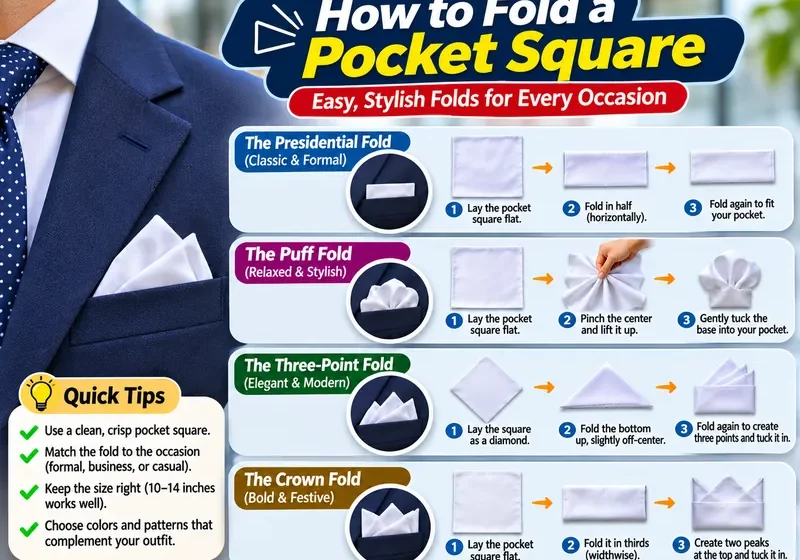
How do you fold a pocket square? Pick the fold by fabric and occasion. For a crisp square (TV) fold, fold a linen or cotton square in half, then into thirds until it is just narrower than your pocket, fold the bottom up to the pocket’s depth and tuck it in. Show no more than about 1.5 inches above the pocket. Silk squares work best in a puff fold. Sources: Gentleman’s Gazette, Ask Andy About Clothes, The Tie Bar.
How to fold a pocket square comes down to two choices: a structured fold (square, one point or two point) for crisp linen and cotton, or a soft fold (puff) for silk. Get the size right for your pocket and the fold will stay put all day. This guide covers five folds step by step, plus the part most guides skip: which fold suits a suit versus a tux, what size square to buy, and how to stop it sinking.
Which Fold Should You Use?
Use the square fold for formal events and tuxedos, the one point or two point for business and weddings, and the puff for relaxed or creative looks. Your fabric decides the rest, because stiff fabric holds sharp lines and silk does not.
| Fold | Difficulty | Best fabric | Best for |
|---|---|---|---|
| Square (TV, Presidential) | Easiest | Stiff linen or cotton | Black tie, business, everyday office |
| One Point | Easy | Linen, cotton, heavier silk | Weddings, business, blazers |
| Two Point | Easy | Linen, cotton | Business suits, formal day events |
| Puff | Easy | Silk, silk-wool | Cocktail parties, sport coats, dates |
| Reverse Puff | Medium | Silk | Casual blazers, creative events |

The Tie Bar recommends structured fabrics such as linen, cotton and woven silk for flat and pointed folds, and flexible printed silk for the puff. The reason is simple: silk is slippery and springs back, so a sharp crease won’t hold, while linen keeps a pressed edge for hours.
How to Fold a Square Pocket Square (The TV Fold)
The square fold leaves a thin, straight strip of fabric parallel to the pocket edge. It is also called the TV fold, the Presidential fold, the straight fold or the classic fold, and it looks best in a relatively stiff linen or cotton square, traditionally white.
- Lay it flat. Press the square if it is linen, since creases from the drawer will show on a straight edge.
- Fold in half left to right, making a tall rectangle.
- Fold the sides in until the width is about half an inch narrower than your pocket opening. Hold it up to the pocket to check rather than guessing.
- Fold the bottom up until the height matches your pocket depth, leaving the top edge clean and folded (not the loose hem).
- Tuck it in with the folded edge on top and parallel to the pocket. Show a thin strip, about a quarter to half an inch.
Practical tip: fold so the extra bulk sits at the bottom of the pocket. That folded base acts as an anchor and keeps the top edge level.
How to Fold a Pocket Square for a Suit
For a suit, a one point or two point fold is the safest choice for work and weddings, and a puff works for evenings or a relaxed sport coat. If you are learning how to fold a suit pocket square for the first time, start with the one point, which is quick to learn and forgives small mistakes. The etiquette for suits is looser than for tuxedos, so you have more freedom with color and pattern.
One Point Fold
The one point fold shows a single triangle above the pocket. Charles Tyrwhitt suggests it for wedding suits and notes it also works with a casual blazer.
- Lay the square flat as a diamond, with one corner pointing up.
- Fold the bottom corner up to meet the top corner, making a triangle.
- Fold the left corner in toward the center, then the right corner, until the width fits your pocket.
- Fold the bottom up to adjust the height and tuck it in, point up.
Two Point Fold
The two point fold creates two peaks side by side and reads slightly more businesslike than a single point.
- Start with the square as a diamond.
- Fold the bottom corner up, but place it a little to the left of the top corner so two peaks appear.
- Fold the sides in to fit the pocket width.
- Fold the bottom up and tuck it in with both peaks showing.
Want three points? After step 2, fold the right corner up and slightly left of the other peaks, then continue. It needs a larger square so the third peak has enough fabric.
Puff Fold
The puff is the easiest fold to get right, because it is meant to look a little loose.
- Lay the square flat and pinch it in the center.
- Lift it so the fabric drapes down.
- Gather the hanging fabric loosely with your other hand.
- Fold the loose ends up behind the puff and tuck everything in so only the rounded top shows.
Reverse puff: follow the same steps, but put the puff into the pocket first so the corners point out instead. Tuck enough fabric in to keep it secure.
How to Fold a Pocket Square for a Tux
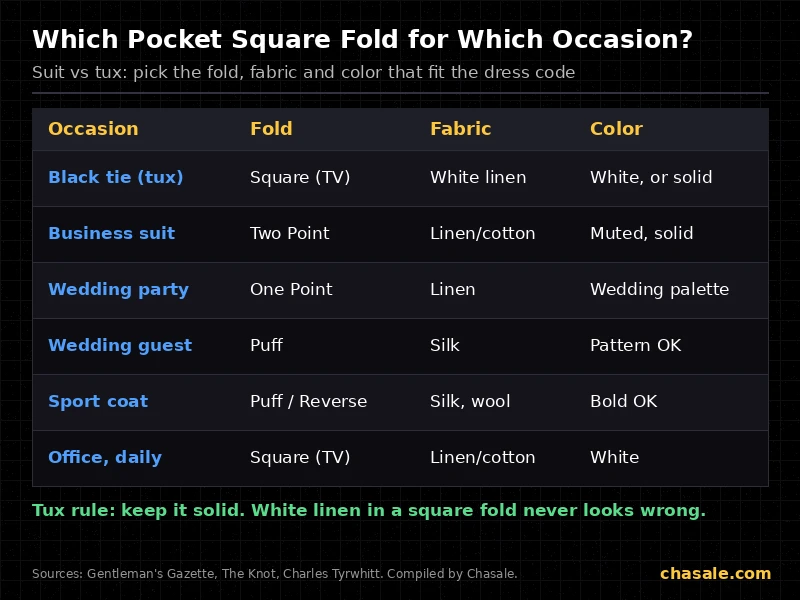
For a tuxedo, the standard is a white linen square in the square (TV) fold. Gentleman’s Gazette calls the white linen TV fold the most classic choice for black tie, and The Knot also recommends a formal fold such as the Presidential with a solid color, with white usually the best bet.
What’s acceptable at black tie:
- Safest: white linen or cotton, square fold. Crisp and timeless.
- Also fine: a white puff or crown fold, if the square and its size suit the fold.
- A touch of color: a solid color such as red or purple can add an accent to a black and white outfit. Keep it solid, not patterned.
- Skip it entirely: some purists argue a tuxedo needs no pocket square at all. This is a matter of taste, not a rule you will be judged on at most events.
Common tux mistake: matching the pocket square fabric exactly to a satin or silk bow tie. A matching set looks bought as a kit. Contrast works better: white linen beside black silk.
What Size Pocket Square Should You Buy?
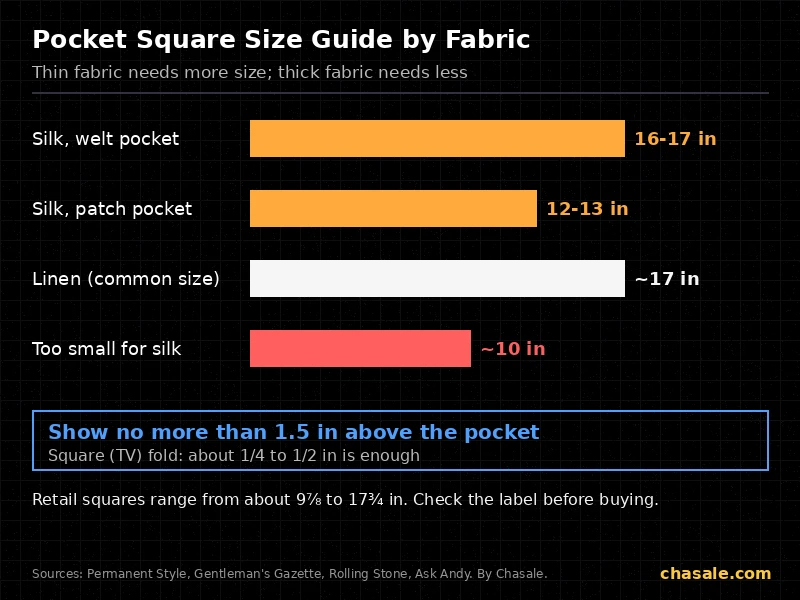
Most silk squares need to be 16 to 17 inches for a standard welt chest pocket, while 12 to 13 inches suits a patch pocket. Heavier fabrics can be smaller, because they fill the pocket with less material.
| Fabric | Typical size that works | Why |
|---|---|---|
| Silk (welt pocket) | 16 to 17 in | Thin and slippery, needs volume to stay up |
| Silk (patch pocket) | 12 to 13 in | Patch pockets are shallower |
| Linen | Around 17 in is common | Crisp, holds folds well |
| Wool, heavy linen | Smaller than silk | Thick fabric bulks up quickly |
Permanent Style notes these two size bands for silk squares, and Gentleman’s Gazette gives the general rule that thicker fabrics should be smaller and thinner fabrics larger. Check the label before you buy: retail squares range from about 9⅞ to 17¾ inches, so a cheap 10-inch silk square is very likely to disappear into your pocket.
How Much of the Pocket Square Should Show?
Show no more than about 1.5 inches above the pocket. For a square fold, a quarter to half an inch is enough. A square that creeps too far out ends up dominating the jacket instead of finishing it.
The quick check: look in a mirror from about six feet away. If the pocket square is the first thing you notice before your face or tie, push it down.
Why Your Pocket Square Keeps Sinking (and How to Fix It)
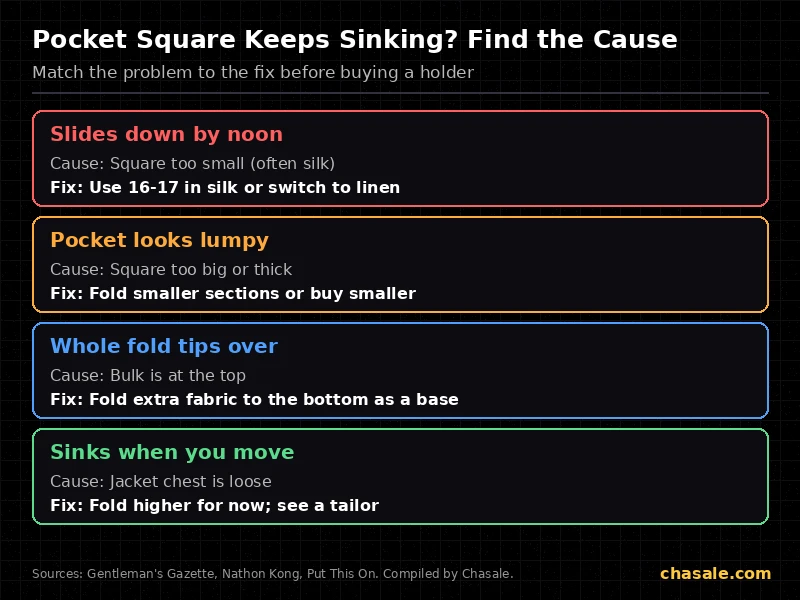
A pocket square usually sinks for one of three reasons: it is too small, your jacket is too loose, or the fold has no base to rest on. Each has a simple fix.
- Too small: a small silk square slides down because it doesn’t have enough fabric to fill the pocket. Switch to a 16 to 17 inch silk square, or use linen, which grips better.
- Loose jacket: a jacket that moves around on your body shakes the square down, and a loose chest leaves the pocket slack. Tailoring fixes this. In the meantime, fold the bottom up more so the square sits higher.
- No base: if all the bulk is at the top, the fold tips over. Fold the extra fabric at the bottom of the square so it rests on the pocket floor.
- Too big: the opposite problem. An oversized square bunches up and spoils the line of your chest. Fold it into smaller sections, or choose a smaller square.
Felt and magnetic pocket square holders also exist. They work, but treat them as a backup. Fixing the size and fold usually solves the problem for free.
How to Match a Pocket Square with Your Tie and Shirt
Your pocket square should complement your tie, not copy it. Pick a square that shares one color with the tie but uses a different pattern or texture.
Real examples that work:
- Navy suit, burgundy tie: white linen square with a burgundy border, in a two point fold.
- Grey suit, navy knit tie: light blue silk square with a small dot, in a puff.
- Black tuxedo, black silk bow tie: plain white linen, square fold.
Also watch your shirt. Rampley & Co points out that a bright white square next to a cream shirt makes the shirt look off-white rather than warm. Pair cream shirts with ivory or patterned squares instead.
Pocket Square vs Handkerchief
A pocket square is for show, and a handkerchief is for use. Gentleman’s Gazette sums it up with an old saying: one is for showing, the other is for blowing. Keep a separate cotton handkerchief in your trouser pocket so you never have to unfold your pocket square in public.
Caring for Your Pocket Squares
Take linen squares out of your jacket after wearing them, because linen wrinkles easily and sitting folded in a pocket sets the creases. Press linen and cotton before a square fold. Store silk squares flat or loosely rolled so they don’t pick up hard lines that fight a puff fold.
Frequently Asked Questions
What is the easiest pocket square fold?
The puff fold is the easiest because it is meant to look relaxed, so small imperfections don’t show. The square fold is the easiest structured option.
What pocket square fold is best for a wedding?
For a groom or wedding party, a one point or square fold in white or a color matched to the wedding palette works well. Guests can wear a puff in silk with a suit.
Can you wear a pocket square without a tie?
Yes. A pocket square works well with an open collar, especially with a blazer or sport coat. A puff or a casual one point fold fits that relaxed look better than a sharp square fold.
What color pocket square goes with a tuxedo?
White is the classic choice. A solid color such as red or purple is acceptable if you want an accent, but avoid busy patterns at black tie.
Should my pocket square match my tie?
No. It should complement the tie by sharing a color, not repeat the same fabric and pattern. Identical sets tend to look like a packaged kit.
Try It Before the Big Day
Practice your chosen fold twice with your actual jacket before an important event, since every pocket has a slightly different depth. If you are dressing for a wedding, our guides on antique vs modern engagement rings and bezel set engagement rings can help you plan the rest of the look, and you can measure your ring size at home without a jeweler. For more style and practical guides, browse Chasale Lifestyle and the Chasale how-to guides.
Last updated: 29 November 2026
