







How Do the Characteristics of Mother and Father Pass to a Child? What Each Parent Really Gives

Quick Answer
How do the characteristics of mother and father pass to a child?
Through heredity. The egg and the sperm each carry 23 chromosomes, which pair up into 46 at fertilisation, so the child receives one copy of most genes from each parent. Dominant, recessive and many-gene effects decide which traits show. Mitochondrial DNA comes only from the mother, while the father’s X or Y sets the baby’s sex.
Source: NHGRI (genome.gov), MedlinePlus Genetics (NIH)
How do the characteristics of mother and father end up mixed inside one small baby, so that a child can have Papa’s curly hair, Mummy’s blood group and a nose that looks like neither? The short version is that each parent hands over one half of a genetic instruction set, and the child’s body reads both halves together. The interesting part is that the two halves are not treated identically. Some instructions can only come from the mother, some only from the father, and a few genes even “remember” which parent they came from.
This guide walks through that process the way a curious parent or a Class 10 student would want it: what physically travels from parent to child, how the two copies decide a trait, and what parts of a child are not written in genes at all.
The 46-Chromosome Handshake at Fertilisation
Almost every cell in your body holds the same genetic library. Humans have 23 pairs of chromosomes, 46 in total, according to the National Human Genome Research Institute (NHGRI). Twenty-two of those pairs are autosomes, and the 23rd pair is the sex chromosomes (XX in most females, XY in most males).
Sperm and egg cells are the exception. They are made through a special cell division called meiosis, which halves the number, so each gamete carries just one copy of every chromosome: 23 in the egg, 23 in the sperm.
At fertilisation, these two half-sets meet and form a zygote with the full 46. From that single cell, every other cell of the baby is copied. That is why NHGRI describes children as inheriting half their chromosomes from their mother and half from their father.
A useful picture: think of each chromosome pair as two copies of the same recipe book, one printed by Mummy’s side and one by Papa’s side. Same chapters, same recipes, but small differences in the ingredients. Those small differences are called alleles, the different versions of the same gene.
How Do the Characteristics of Mother and Father Combine Inside One Child?
Having two copies of a gene does not mean the child shows a 50:50 blend. The two alleles interact in a few predictable ways, plus one messy, real-world way.
Dominant and recessive: one copy can hide the other
Gregor Mendel worked this out with pea plants in 1866. When one allele is dominant, a single copy is enough for the trait to show. A recessive allele only shows when the child receives it from both parents.
This explains a common family surprise. Britannica notes that a brown-eyed mother and a brown-eyed father will not necessarily produce a brown-eyed child, because both can quietly carry a hidden recessive version and pass it on together.
Codominance: both copies show up

Sometimes neither allele wins. The ABO blood group is the classic example, listed as codominant by MedlinePlus Genetics. A child who gets an A allele from one parent and a B allele from the other has blood group AB, showing both.
Here is a real situation that confuses many Indian families. A mother with blood group A (genotype AO) and a father with blood group B (genotype BO) can have children of all four blood groups: A, B, AB and O, each with a 25% chance per pregnancy. A child with group O in such a family is completely normal genetics, not a mix up at the hospital.
Polygenic traits: many genes, one result
Most traits you notice in a face are not controlled by one gene. Eye colour was once taught as a simple brown-over-blue trait, but MedlinePlus explains it depends on several genes, with two neighbouring genes on chromosome 15, OCA2 and HERC2, playing the biggest role. Height, skin tone and body build work the same way. Dozens or hundreds of small genetic nudges add up, which is why a child’s height often lands somewhere between the parents’ heights instead of matching either one exactly.
The Parent-by-Parent Ledger: What Only Mom or Only Dad Can Give

Most textbook answers stop at “half from each parent.” That is true for the autosomes, but four parts of inheritance are lopsided, and they explain a lot of real family patterns.
| What is passed on | From mother | From father |
|---|---|---|
| 22 autosomes | Yes, one of each pair | Yes, one of each pair |
| Sex chromosome | Always an X | X (daughter) or Y (son) |
| Mitochondrial DNA (37 genes) | Yes, to all children | No |
| Imprinted genes | Some active only from mother’s copy | Some active only from father’s copy |
1. The father’s sperm decides the baby’s sex
The mother’s egg always carries an X chromosome. The father’s sperm carries either an X or a Y. An X sperm produces a girl (XX) and a Y sperm produces a boy (XY). This is also covered in the NCERT Class 10 chapter on heredity, and it quietly answers an old social myth: the mother’s body does not “choose” the baby’s sex.
2. Mitochondrial DNA comes only from the mother
Mitochondria, the energy producers inside cells, carry their own tiny genome. MedlinePlus describes mitochondrial DNA as about 16,500 base pairs holding 37 genes. Because only the egg contributes mitochondria to the embryo, this DNA is passed down the maternal line almost without exception. Brothers and sisters share their mother’s mitochondrial DNA, and so did their mother with her own mother.
3. Sons get their only X from their mother
A boy’s single X chromosome always comes from his mother. That matters for X-linked recessive conditions such as haemophilia and red-green colour blindness. A son has no second X to cover a faulty copy, so if he inherits one, the trait shows. MedlinePlus also notes that fathers cannot pass X-linked traits to their sons, since they give sons a Y, not an X.
A practical example: if a mother has red-green colour blindness (both her X chromosomes carry the variant), every son she has will be colour blind too, even when the father has normal vision.
4. Genomic imprinting: some genes remember their parent
This is the part almost no school answer mentions. For a small percentage of human genes, only one parent’s copy is switched on. MedlinePlus calls this genomic imprinting. Two well-known clusters sit on chromosomes 11 and 15. When the imprinting on chromosome 15 goes wrong, it can lead to Prader-Willi syndrome or Angelman syndrome depending on which parent’s copy is missing. These conditions are rare, but they prove that “one copy from each parent” is not always an equal partnership.
Why Siblings With the Same Parents Look So Different
If both children get half from Mummy and half from Papa, why does one sibling look like a photocopy of Dadi while the other resembles Nanaji?
Because it is never the same half. During meiosis, each of the 23 chromosome pairs is sorted into the egg or sperm independently. That alone gives 2 raised to the power 23, which is 8,388,608 possible chromosome combinations from a single parent. On top of that, crossing over swaps segments between the paired chromosomes before they separate, creating combinations that did not exist in either grandparent.
Multiply the mother’s possibilities by the father’s, and two siblings (apart from identical twins) are, on average, sharing only about half of their DNA with each other. MedlinePlus uses the same figure: non-twin siblings share about 50% of their DNA, while identical twins share 100%.
Traits Genes Do Not Fully Decide
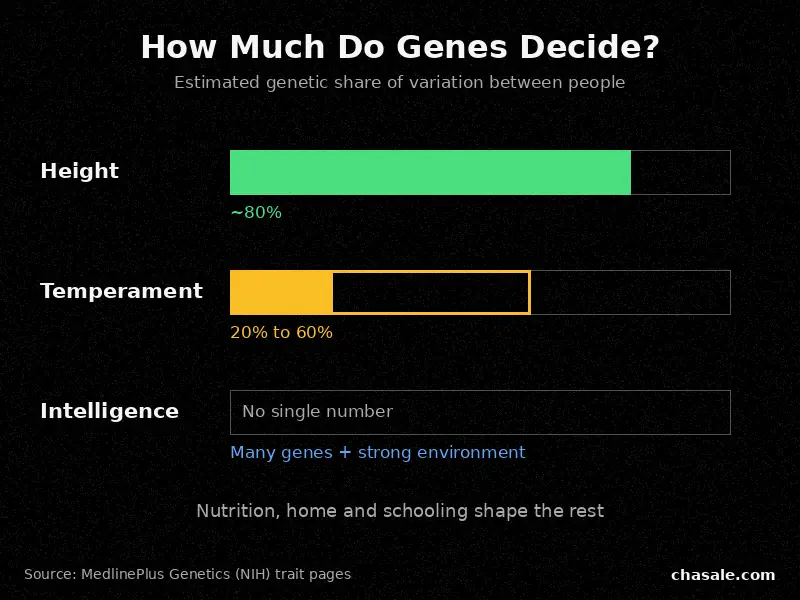
Parents often ask “kiski aadat aayi hai?” when a child shows a habit or personality streak. Science gives a more balanced answer.
- Height: MedlinePlus estimates that about 80% of a person’s height is shaped by inherited DNA variations. The remaining share comes from factors like nutrition, which is why a well-fed generation often outgrows its parents.
- Temperament: Shyness, energy level and focus are partly inherited. MedlinePlus puts genetics at roughly 20% to 60% of temperament, with no single “temperament gene.”
- Intelligence: You may have seen viral posts claiming intelligence comes only from the mother. MedlinePlus says something quite different: intelligence likely involves many genes, each with a small effect, and it is strongly influenced by home environment, parenting and education.
So a child is not a fixed printout of the parents. Genes set a range of possibilities, and daily life (food, sleep, school, encouragement) decides where in that range the child lands. If you have ever felt boxed in by “it runs in the family,” our guide on how to believe in yourself when nobody else does is a good companion read.
Why This Matters for Indian Families: The Thalassemia Example
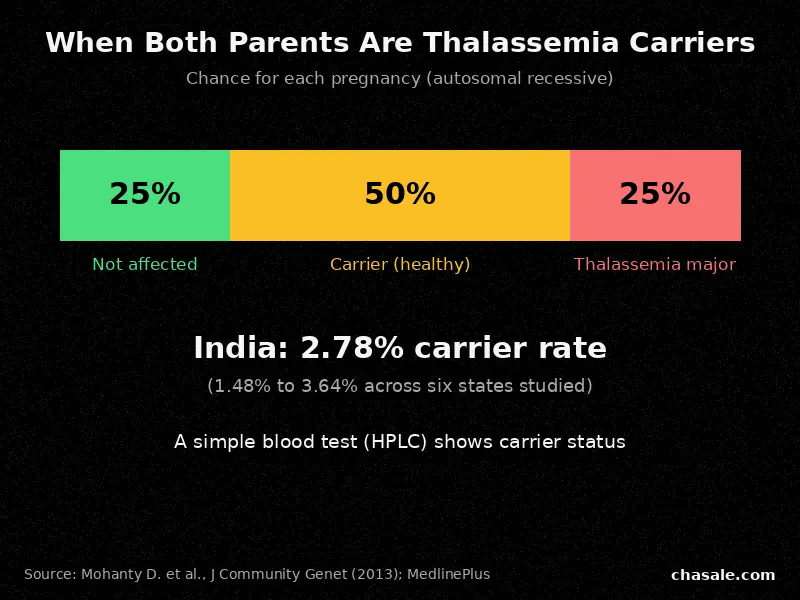
Heredity is not just exam material. It shows up in very real health decisions, and beta thalassemia is the clearest Indian example.
Thalassemia is an autosomal recessive condition. A person with one altered copy is a carrier (often called thalassemia minor or trait) and is usually healthy. A multicentre study covering six cities in six Indian states, published in the Journal of Community Genetics, found an overall carrier rate of 2.78%, ranging from 1.48% to 3.64% between states and much higher in some communities.
The trouble starts when two carriers have children together. For every pregnancy:
- 25% chance the child has two normal copies
- 50% chance the child is a healthy carrier, like the parents
- 25% chance the child inherits both altered copies and has thalassemia major, which usually needs lifelong blood transfusions
Neither parent may have any symptoms, so the risk stays invisible until a simple blood test (usually HPLC) reveals carrier status. Government guidelines under the National Health Mission recommend screening pregnant women during antenatal check-ups and pre-marital counselling at the college level. If you are planning marriage or a pregnancy, ask your doctor about a carrier test. It is one of the most practical uses of everything this article has explained.
Try This: Map One Trait Across Three Generations
Reading about inheritance is one thing; seeing it in your own family makes it stick. Here is a 15-minute exercise that works for students and parents alike.
- Pick one visible or known trait. Blood group is ideal because it is written on health records. Curly versus straight hair also works.
- List three generations. Grandparents on both sides, parents, and children.
- Write the trait for each person. Leave a blank where you do not know.
- Look for the patterns from this article. Does an O blood group appear in a child even though neither parent is O? That points to both parents being AO or BO carriers. Do several boys on the mother’s side share a trait the girls do not? That hints at an X-linked pattern.
- Note what genes cannot explain. Height differences between generations often reflect better nutrition, not “new” genes.
If you like keeping notes like this, the methods in our post on journaling techniques can turn it into a family record your children will value later.
Frequently Asked Questions
Do children get more DNA from the mother or the father?
The nuclear DNA in chromosomes is split evenly, 23 chromosomes from each parent. The mother adds a little extra through mitochondrial DNA, which has 37 genes. So the mother’s total contribution is very slightly larger, but the difference is tiny compared with the full genome.
Who decides whether the baby is a boy or a girl?
The father’s sperm decides. The mother’s egg always carries an X chromosome, while each sperm carries either an X or a Y. A Y-carrying sperm leads to a boy and an X-carrying sperm leads to a girl. The mother’s body, diet or timing does not change this.
Can a child have a blood group different from both parents?
Yes. A parent with group A can carry a hidden O allele (AO), and so can a parent with group B (BO). Their children can be A, B, AB or O. Because the A and B alleles are codominant and O is recessive, a child’s blood group can legitimately differ from both parents.
Is intelligence inherited only from the mother?
No. That claim spreads widely online, but the NIH’s MedlinePlus Genetics describes intelligence as involving many genes with small effects, along with strong environmental influences like education and home life. Both parents contribute genetic factors, and upbringing matters a great deal.
Can acquired traits, like gym muscles, be passed to children?
No. Muscle gained from exercise or a skill learned in life changes the body, not the DNA in the egg or sperm. Only traits written in the parents’ reproductive cells are inherited. This is why NCERT separates inherited traits from acquired traits.
Explore More on Chasale
Heredity is a good reminder that small, invisible details can shape big outcomes. At Chasale, we break down everyday science, life questions and practical guides in plain language. Learn more about what we cover on our about Chasale page, and share this guide with a student or parent who keeps asking “where did that trait come from?”
Disclaimer
This article is for general educational information only and is not medical or genetic advice. Inheritance patterns described here are simplified for learning. For questions about inherited conditions, carrier testing, pregnancy planning or a family history of a genetic disorder, please consult a qualified doctor or a certified genetic counsellor.
